Solving Linear Equations with Multiple Terms: A Step-by-Step Guide
When working with algebraic equations, combining like terms and isolating variables are fundamental skills. This guide explains how to solve equations with multiple terms, using a practical example to demonstrate the process.
Introduction
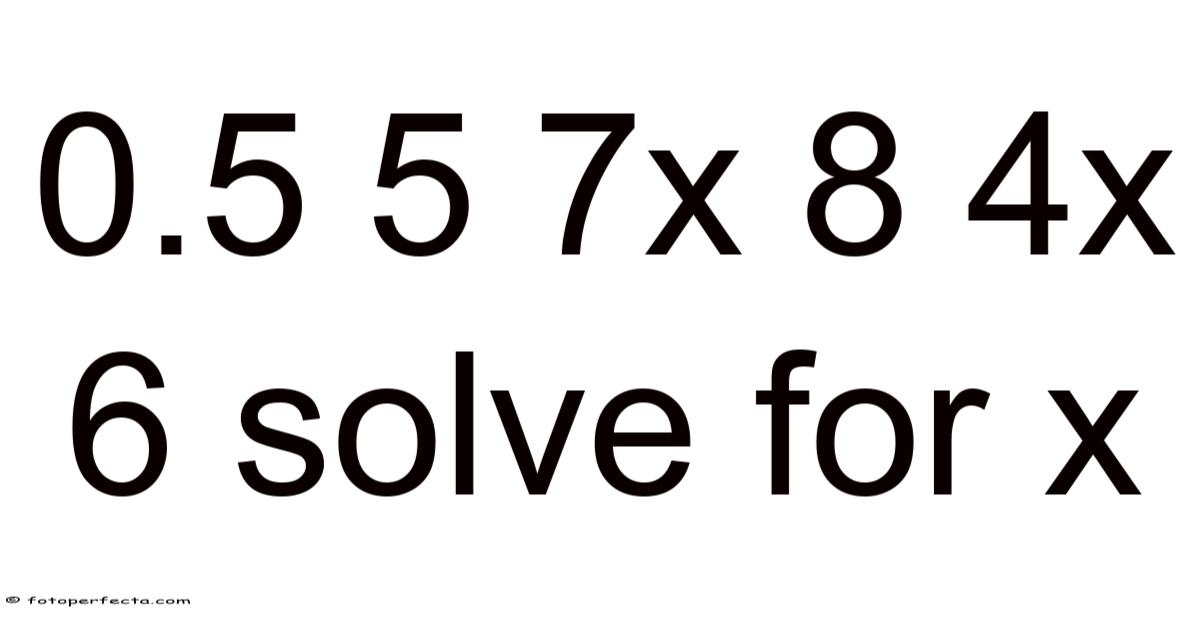
Linear equations form the foundation of algebra and appear frequently in real-world applications. This article walks through solving an equation constructed from the terms 0.But when an equation contains multiple terms, including decimals, integers, and variables, the key is to systematically group and simplify before solving for the unknown. 5, 5, 7x, 8, 4x, and 6 to illustrate these principles And that's really what it comes down to..
Steps to Solve the Equation
Consider the equation:
0.5 × 5 + 7x + 8 + 4x + 6 = 0
Step 1: Multiply Constants
First, perform any multiplication operations.
0.5 × 5 = 2.5
The equation becomes:
2.5 + 7x + 8 + 4x + 6 = 0
Step 2: Combine Like Terms
Group the variable terms (7x and 4x) and constant terms (2.5, 8, and 6):
- Variable terms: 7x + 4x = 11x
- Constant terms: 2.5 + 8 + 6 = 16.5
The simplified equation is:
**11x + 16.5 = 0
Step 3: Isolate the Variable Term
To get the term containing $x$ by itself, you must move the constant to the other side of the equation. This is done by performing the inverse operation; since 16.5 is being added, you subtract 16.5 from both sides:
11x + 16.5 - 16.5 = 0 - 16.5
11x = -16.5
Step 4: Solve for x
The final step is to isolate $x$ by removing its coefficient. Since $x$ is being multiplied by 11, divide both sides of the equation by 11:
11x / 11 = -16.5 / 11
x = -1.5
Verifying the Result
To ensure the answer is correct, substitute -1.5 back into the original equation:
0.5 × 5 + 7(-1.5) + 8 + 4(-1.5) + 6 = 0
2.5 - 10.5 + 8 - 6 + 6 = 0
-8 + 8 + 0 = 0
0 = 0
The left side equals the right side, confirming that $x = -1.5$ is the correct solution Not complicated — just consistent..
Conclusion
Solving linear equations with multiple terms may seem daunting at first, but the process becomes straightforward when broken down into logical steps. By following the order of operations—multiplying first, combining like terms, and then isolating the variable—you can simplify even the most cluttered expressions. Mastering these foundational algebraic techniques not only improves mathematical accuracy but also provides the necessary tools to tackle more complex equations in higher-level mathematics and science Small thing, real impact..
These techniques solidify foundational knowledge, bridging gaps in understanding and enabling precise problem resolution across disciplines. Plus, mastery remains critical for navigating mathematical challenges effectively. Thus, embracing such principles ensures sustained proficiency and adaptability in academic pursuits.
