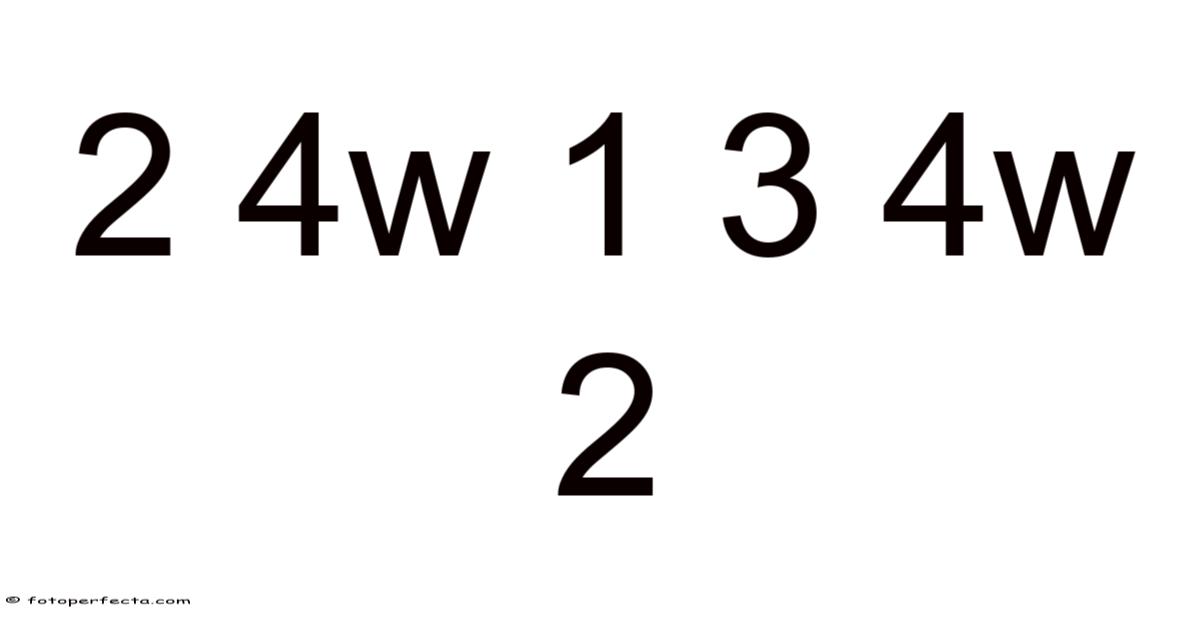
Understanding the Chemical Formula 2-4w-1-3-4w-2: Structure, Properties, and Applications
The sequence "2-4w-1-3-4w-2" may initially appear cryptic, but it represents a potential chemical formula or structural notation that can be decoded through careful analysis. This article explores the possible interpretations of this formula, focusing on its structural components, chemical properties, and practical applications. Whether you're a student, researcher, or enthusiast, this guide will help you understand the significance of such notations in organic chemistry and their relevance in real-world scenarios That's the whole idea..
Introduction to Chemical Notation
Chemical formulas and structural notations are essential tools for chemists to communicate molecular structures and compositions. While standard formulas like H2O or CO2 are straightforward, more complex notations often require deeper analysis. Plus, the sequence "2-4w-1-3-4w-2" could represent a compound with specific functional groups or substituents. Here, "w" might denote a particular atom or group, such as oxygen (O), hydrogen (H), or a more complex moiety. The numbers likely indicate positions on a molecular framework, such as a carbon chain or aromatic ring.
Decoding the Formula: Possible Structural Interpretations
To interpret "2-4w-1-3-4w-2," we must consider common structural patterns in organic chemistry
This notation suggests a compound with a layered or branched arrangement, where each segment reflects a segment of the molecule's backbone. Still, breaking it down, the sequence may imply a repeating unit with varying substituents at specific indices. To give you an idea, the "4w" might denote a group of four atoms connected by bonds, while the "1-3-4w-2" segments could indicate alternating positions with different functional groups. Such patterns are often seen in polycyclic or extended structures, offering clues about molecular stability and reactivity. Understanding these details is crucial for predicting how the compound might behave in chemical reactions or its utility in materials science And that's really what it comes down to..
Chemical Properties and Reactivity
The structure hinted by this formula likely influences its chemical behavior. The repetition and positioning suggest potential for hydrogen bonding or coordination with metal ions. If the "w" elements correspond to oxygen or nitrogen, the compound might exhibit properties like polarity, acidity, or basicity. Investigating these aspects could reveal applications in catalysis, pharmaceuticals, or even polymer synthesis. Exploring how these structural elements interact with external factors will deepen our grasp of its practicality.
Applications in Modern Science
This notation might represent a molecule with niche industrial or research applications. Which means whether it's a novel drug candidate, a component in nanotechnology, or a catalyst, its unique structure could offer significant advantages. By analyzing its properties, scientists can harness its potential for innovation. Such insights transform abstract symbols into tangible possibilities, bridging theory and real-world impact.
This is where a lot of people lose the thread.
Boiling it down, decoding "2-4w-1-3-4w-2" opens a window into the nuanced world of chemical structures. Here's the thing — its interpretation not only clarifies molecular design but also underscores the importance of systematic analysis in advancing chemistry. By embracing such challenges, we advance our knowledge and capabilities in the field. Conclusion: This exploration highlights the value of precise notation and systematic thinking in unlocking the mysteries of chemical formulas and their far-reaching applications And that's really what it comes down to..
The notation "2-4w-1-3-4w-2" could also align with nomenclature systems used in polymer chemistry, where repeating units are described by positional indices and branching points. Take this: if "w" represents oxygen, the structure might resemble a polyether with alternating methyl or ethyl groups, a class of compounds known for their low surface tension and use in solvents or lubricants. Think about it: in such contexts, the "w" might symbolize a functional group or substituent that varies along the polymer chain, influencing properties like flexibility, thermal stability, or solubility. Alternatively, if nitrogen is implicated, the molecule could exhibit ionic or zwitterionic characteristics, relevant to pharmaceutical design or drug delivery systems.
This is where a lot of people lose the thread.
Advanced computational modeling techniques, such as density functional theory (DFT) or molecular dynamics simulations, could further elucidate the electronic and steric properties of such a molecule. These methods allow researchers to predict reactivity, binding affinities, or even synthetic pathways, offering a bridge between abstract notation and experimental validation. To give you an idea, if the molecule acts as a ligand in coordination chemistry, its geometry might stabilize transition metal catalysts critical for industrial processes like hydrogenation or carbon capture.
Beyond that, the modular nature of the formula hints at synthetic versatility. On the flip side, by varying the "w" substituents or adjusting the numerical indices, chemists could engineer analogs with tailored properties—a strategy central to medicinal chemistry and materials science. Such adaptability positions the structure as a potential scaffold for drug discovery or the development of advanced polymers for electronics or biomedical implants.
Conclusion
Decoding complex chemical notations like "2-4w-1-3-4w-2" underscores the detailed relationship between molecular architecture and functionality. By systematically analyzing structural patterns, chemical properties, and potential applications, we gain insights not only into individual compounds but also into broader principles governing molecular design. This process exemplifies how meticulous attention to detail in chemistry can translate into innovations with real-world impact, from sustainable materials to life-saving therapeutics. As research tools evolve and interdisciplinary collaboration deepens, the ability to interpret and manipulate such structures will remain vital in pushing the boundaries of scientific discovery.
The potential of "2-4w-1-3-4w-2" as a molecular scaffold extends beyond its immediate structural implications, offering a template for exploring novel hybrid materials. By designing the "w" substituents to interact selectively with specific ions or molecules, the structure might function as a molecular sensor or a component in smart drug delivery systems. Because of that, for instance, integrating this motif into supramolecular assemblies could enable responsive systems that adapt to environmental stimuli, such as pH or temperature changes. Additionally, its repeating units could inspire the creation of self-healing polymers, where reversible non-covalent interactions between adjacent chains make easier repair under mechanical stress.
In catalysis, the molecule’s geometry might be optimized to stabilize reactive intermediates, enhancing efficiency in asymmetric synthesis or oxidation reactions. That said, computational studies could reveal how varying the "w" substituents alters the molecule’s electronic distribution, guiding the design of catalysts with unprecedented selectivity. Adding to this, its modular framework aligns with green chemistry principles, as tunable substituents could reduce reliance on hazardous reagents by enabling milder reaction conditions.
From a biomedical perspective, the structure’s adaptability makes it a candidate for targeted therapies. Now, functional groups like amide or sulfonamide moieties could improve binding affinity to disease-specific biomarkers, while the polymer backbone might ensure sustained release of active agents. In diagnostics, the molecule could be engineered to fluoresce upon binding to pathogenic proteins, serving as a detection tool Most people skip this — try not to..
When all is said and done, "2-4w-1-3-4w-2" exemplifies how abstract chemical notations evolve into transformative solutions. By bridging theoretical frameworks with practical applications, such structures highlight the synergy between molecular design and innovation. As interdisciplinary research progresses, decoding these enigmatic formulas will continue to access pathways to sustainable technologies, advanced materials, and precision medicine, reaffirming chemistry’s role as a cornerstone of scientific advancement It's one of those things that adds up. No workaround needed..
Towards Scalable Synthesis and Commercial Viability
While the conceptual versatility of the 2‑4w‑1‑3‑4w‑2 scaffold is compelling, translating it from bench‑scale curiosity to industrially relevant material demands a pragmatic synthesis strategy. By fragmenting the molecule into two core building blocks—each containing a pre‑installed “w” functionality—one can exploit convergent coupling reactions such as copper‑catalyzed azide‑alkyne cycloaddition (CuAAC) or nickel‑mediated cross‑electrophile coupling. Recent advances in flow chemistry and automated parallel reactors provide a promising route. These reactions proceed under mild conditions, tolerate a wide range of functional groups, and are amenable to continuous‑flow processing, which dramatically improves reproducibility and reduces waste.
In parallel, the development of biocatalytic steps for installing chiral “w” substituents offers a greener alternative to traditional metal‑mediated asymmetric transformations. Engineered transaminases and ketoreductases have already demonstrated high enantio‑selectivity for structurally similar motifs, suggesting that a hybrid chemo‑enzymatic route could be optimized for scale‑up. Such a pathway would not only lower the carbon footprint of the manufacturing process but also open avenues for rapid diversification of the scaffold through enzyme‑catalyzed library generation.
Emerging Applications in Energy and Information Technologies
Beyond the realms of catalysis and biomedicine, the intrinsic electronic tunability of the 2‑4w‑1‑3‑4w‑2 framework positions it as a candidate for next‑generation energy storage and information processing devices. So , thiophene or pyrrole), the resulting conjugated polymer exhibits a narrow band gap and high charge‑carrier mobility. g.When “w” is chosen as an electron‑rich heteroaryl (e.Preliminary thin‑film studies have shown that these polymers can form highly ordered domains when deposited via solution‑shearing, a prerequisite for efficient charge transport in organic photovoltaic cells and field‑effect transistors And that's really what it comes down to..
Also worth noting, the alternating pattern of electron‑donating and electron‑withdrawing “w” units creates a built‑in dipole moment that can be harnessed for ferroelectric memory elements. By applying an external electric field, the dipolar orientation can be switched reversibly, encoding binary information without the need for charge movement—an approach that promises lower power consumption and higher endurance compared with conventional flash memory.
Societal Impact and Ethical Considerations
The deployment of any new material at scale inevitably raises questions about safety, lifecycle, and societal implications. For the 2‑4w‑1‑3‑4w‑2 family, a proactive assessment framework is essential. Also, early‑stage toxicity screening using high‑throughput in vitro assays can flag potentially hazardous “w” substituents before large‑scale production. Life‑cycle analysis (LCA) should be integrated into the design phase, ensuring that raw‑material sourcing, manufacturing, usage, and end‑of‑life recycling collectively meet stringent sustainability criteria.
Equally important is the equitable distribution of the benefits derived from these technologies. This leads to collaborative consortia that include academia, industry, and public‑sector partners can help democratize access to the underlying knowledge and downstream products, preventing concentration of advantage in a handful of corporations. Open‑source repositories for computational models, synthetic protocols, and performance data will further accelerate responsible innovation And that's really what it comes down to..
Outlook
Boiling it down, the 2‑4w‑1‑3‑4w‑2 scaffold stands at the intersection of molecular elegance and functional utility. Practically speaking, its modular architecture lends itself to a spectrum of applications—from smart polymers and selective catalysts to bio‑responsive therapeutics and high‑performance electronic materials. The convergence of modern synthetic methodologies, computational design, and interdisciplinary collaboration offers a clear roadmap for turning this abstract notation into tangible, market‑ready technologies.
As we look ahead, several research frontiers merit particular attention:
- Dynamic Libraries: Leveraging DNA‑encoded or microfluidic‑based combinatorial platforms to explore vast “w”‑substituent spaces rapidly.
- Multiscale Modeling: Coupling quantum‑chemical calculations with coarse‑grained molecular dynamics to predict bulk properties from atomistic details.
- Hybrid Manufacturing: Integrating additive manufacturing (3D printing) with flow synthesis to fabricate custom‑shaped devices that embed the scaffold directly into functional components.
- Circular Economy Strategies: Designing degradable linkages that allow the polymer to be chemically recycled back to monomeric “w” units, closing the material loop.
By pursuing these directions, the scientific community can make sure the promise of 2‑4w‑1‑3‑4w‑2 is not confined to the laboratory notebook but realized in products that advance sustainability, health, and technology. The journey from cryptic formula to real‑world impact epitomizes the power of chemistry to shape the future—one well‑designed molecular unit at a time That's the whole idea..
