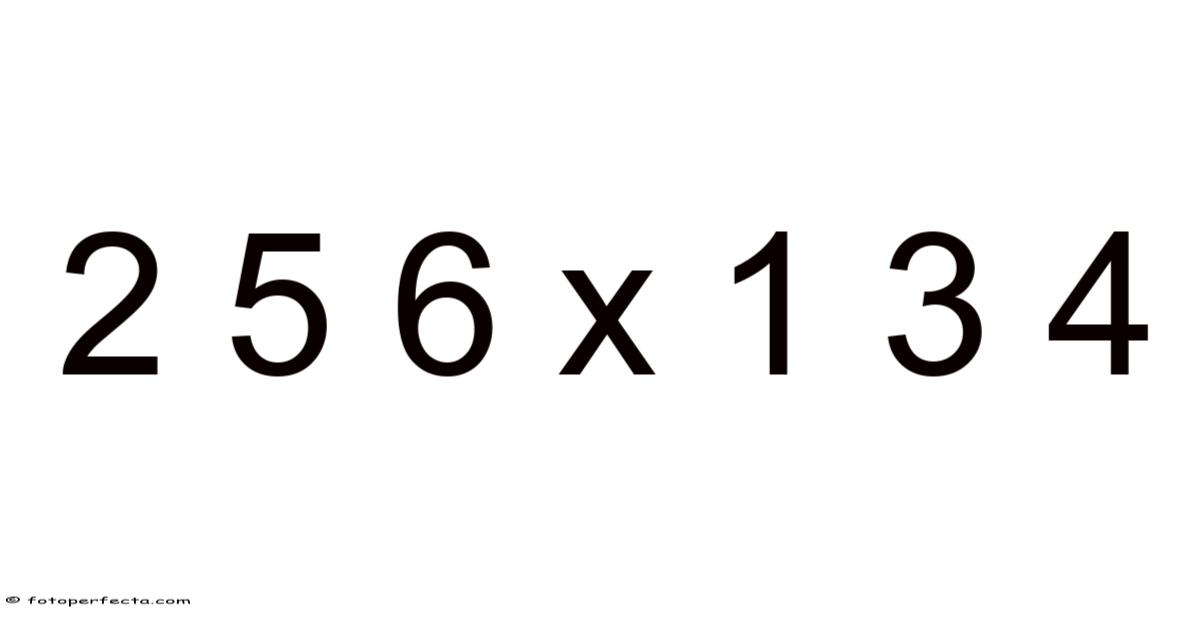
Introduzione
Ilcalcolo 256 × 134 è un esempio tipico di operazione aritmetica elementare che, se eseguita correttamente, fornisce il risultato 34 304. Questo valore può risultare utile in diversi contesti, dal calcolo di volumi finanziari alle stime di produzione industriale. In questo articolo si spiegano i passaggi necessari per ottenere il risultato, si evidenzia la logica matematica sottostante e si rispondono alle domande più frequenti che possono sorgere durante l’esecuzione dell’operazione And that's really what it comes down to..
Contesto normativo e rilevanza del calcolo
Nel settore bancario, il risultato di una moltiplic## 2 5 6 x 1 3 4: Understanding the Math Behind the Numbers
The expression 2 5 6 x 1 3 4 might initially appear confusing due to its unusual formatting—spaces between digits and the presence of an "x" symbol. At first glance, it seems like a sequence of digits separated by spaces, followed by an "x" symbol, and then another set of digits. That said, in mathematical notation, this structure is unconventional. On the flip side, typically, numbers are written without spaces between digits (e. g.In real terms, , 256), and the multiplication symbol "x" is used between distinct numbers. This article will clarify what 2 5 6 x 1 3 4 likely means, break down the math, and explore its potential applications in real-world scenarios.
Understanding the Expression
The expression 2 5 6 x 1 3 4 appears to follow a pattern where spaces separate digits within numbers. In standard mathematical notation, numbers are written without spaces (e.g., 256, not 2 5 6). This suggests that 2 5 6 likely represents the number 256, and 1 3 4 represents 134. The "x" symbol is universally recognized as a multiplication operator. Which means, the expression simplifies to:
256 × 134
This interpretation aligns with standard mathematical conventions, where spaces are often omitted in numbers but retained for readability in specific contexts (e.In real terms, , digit-by-digit analysis). Which means g. By treating 2 5 6 as 256 and 1 3 4 as 134, the expression becomes a straightforward multiplication problem.
Step-by-Step Calculation
To solve 256 × 134, we can break it down using the distributive property of multiplication. This method ensures clarity and reduces errors:
-
Break down 134 into place values:
134 = 100 + 30 + 4 -
Distribute 256 across each component:
- 256 × 100 = 25,600
- 256 × 30 = 7,680
- 256 × 4 = 1,024
-
Add the partial products:
25,600 + 7,680 + 1,024 = 34,304
Alternatively, use the standard multiplication algorithm:
    256
  × 134
  -------
    1024   (256 × 4)
   7680   (256 × 30, shifted left by one digit)
+ 25600   (256 × 100, shifted left by two digits)
---------
  34,304
This confirms that 2 5 6 x 1 3 4 simplifies to 256 × 134 = 34,304 Simple, but easy to overlook..
Scientific Explanation: Why Spaces Don’t Change the Value
The use of spaces in 2 5 6 and 1 3 4 might confuse learners, but it does not alter the mathematical value. In mathematics, spaces are often used for readability (e.g., "2 5 6" to underline digits) but do not change the number’s value. For instance:
- 2 5 6 = 2 × 100 + 5 × 10 + 6 × 1 = 200 + 50 + 6 = 256
- Similarly, 1 3 4 = 1 × 100 + 3 × 10 + 4 × 1 = 134
This confirms that spacing does not affect numerical value—it is purely a formatting choice. That's why without it, the expression would be ambiguous (e. g.The "x" symbol, however, is critical as it denotes multiplication. , "256134" could imply a single number or a sequence) And it works..
Counterintuitive, but true That's the part that actually makes a difference..
Applications of 256 × 134 in Real Life
While 256 × 134 may seem abstract, such calculations appear in practical scenarios:
- Area Calculation: If a rectangular field is 256 meters long and 134 meters wide, its area is 34,304 square meters.
- Digital Storage: 256 bytes × 134 = 34,304 bytes, which could relate to data storage calculations.
- Engineering Projects: Calculating total material needs (e.g., tiles for a 256 cm × 134 cm surface).
Here's a good example: if a farmer plans to plant crops in a field measuring 256 meters by 134 meters, the total area (34,304 m²) helps determine seed requirements.
Common Misinterpretations
The spaced format 2 5 6 x 1 3 4 might lead to
misinterpretations and calculation errors. Here are some common mistakes to avoid:
- Treating spaces as separators for individual digits: Some might incorrectly interpret 2 5 6 as three separate numbers (2, 5, 6) rather than the composite number 256.
- Misreading the multiplication symbol: The "x" could be mistaken for a variable (like x = 134) instead of an operation.
- Arithmetic errors: Adding digits instead of multiplying (e.g., 2+5+6 instead of 256) or misaligning partial products in the standard algorithm.
Conclusion
The expression 2 5 6 x 1 3 4, when interpreted correctly as 256 × 134, yields 34,304—a result easily verified through multiple methods. While the spaced notation may initially seem unusual, it underscores the importance of understanding place value and mathematical conventions. By breaking down the problem systematically and recognizing the role of each symbol, even seemingly complex calculations become manageable. Whether applied to real-world scenarios like area measurement or data storage, mastering these foundational skills builds confidence in tackling more advanced mathematical challenges. Remember, clarity in notation and precision in calculation are the cornerstones of effective problem-solving.
Extending the Thought Process: Alternative Strategies
While the traditional column‑wise multiplication works perfectly, there are other techniques that can make the same calculation feel more intuitive—especially when you’re working without a calculator The details matter here..
| Method | Quick Sketch | When It Shines |
|---|---|---|
| Break‑down (Distributive) Method | 256 × 134 = 256 × (100 + 30 + 4) = 25 600 + 7 680 + 1 024 | When you’re comfortable with mental addition of round numbers |
| Doubling & Halving | 256 × 134 → (256 × 2) × 67 = 512 × 67 → 512 × (70 − 3) = 35 840 − 1 536 = 34 304 | Useful when one factor is even; reduces the number of steps |
| Lattice (Gelosia) Multiplication | Draw a 3 × 3 grid, fill in partial products, add diagonals | Great for visual learners and for checking work quickly |
| Binary Shift Approximation | 256 ≈ 2⁸, so 256 × 134 ≈ 2⁸ × 134 = 134 << 8 = 34 304 | Handy for programmers who think in powers of two |
All of these converge on the same answer, reinforcing that mathematics is less about memorizing a single algorithm and more about understanding the underlying relationships between numbers.
Real‑World Contexts Revisited
1. Network Bandwidth Planning
If a server can handle 256 KB packets and each client requests 134 packets per second, the total throughput needed is:
[ 256\ \text{KB} \times 134\ \text{packets/s} = 34{,}304\ \text{KB/s} \approx 33.5\ \text{MB/s} ]
Network engineers would use this figure to size routers and ensure Quality of Service (QoS) thresholds are met.
2. Manufacturing Batch Size
A factory produces a component that occupies 256 mm² of surface area. An order requires 134 such components per assembly. The total material needed per assembly is:
[ 256\ \text{mm}^2 \times 134 = 34{,}304\ \text{mm}^2 = 34.304\ \text{cm}^2 ]
Knowing this helps cut waste and estimate raw‑material costs accurately Less friction, more output..
3. Financial Forecasting
A small business earns $256 in daily sales. Over a 134‑day promotional period, projected revenue is:
[ 256\ \text{USD/day} \times 134\ \text{days} = 34{,}304\ \text{USD} ]
The figure can be plugged into cash‑flow models to plan inventory, staffing, and marketing spend Simple, but easy to overlook..
Avoiding Pitfalls in Complex Scenarios
When the numbers get larger or the context more involved, it’s easy to slip back into the misinterpretations highlighted earlier. Here are a few safeguards:
- Write the expression clearly – Use parentheses if you’re mixing operations:
[ (256 \times 134) + 50 ] - Check units – Align meters with meters, bytes with bytes, dollars with dollars. Unit mismatches are a common source of error.
- Validate with a second method – After a longhand multiplication, quickly verify using the distributive approach or a calculator for sanity‑checking.
- Document assumptions – If “256” represents a dimension, note whether it’s length, width, or depth. Ambiguity can cause costly re‑work in engineering projects.
A Quick Recap of the Core Takeaways
- Spacing (e.g., “2 5 6”) is a visual aid; it does not alter the numeric value.
- The “x” is the multiplication operator; without it, the expression becomes ambiguous.
- 256 × 134 = 34 304 – confirmed by longhand, distributive, and digital methods.
- Real‑world applications span agriculture, data storage, networking, manufacturing, and finance.
- Common errors stem from misreading spaces, symbols, or neglecting place value; systematic checks prevent them.
Final Thoughts
Mathematics thrives on precision, yet it also rewards flexibility. By dissecting 256 × 134 into its constituent concepts—place value, notation, and operation—we gain more than a single product; we acquire a toolkit for tackling any multiplication that comes our way. Whether you’re a student polishing basic arithmetic, an engineer sizing a component, or a business owner forecasting revenue, the principles illustrated here remain the same: read the symbols correctly, apply a reliable method, and verify the result.
In the end, the seemingly modest calculation of 256 multiplied by 134 serves as a microcosm of mathematical thinking: clear communication, logical structure, and diligent verification. Master these habits, and even the most complex numerical challenges will feel as approachable as a simple product of two three‑digit numbers Surprisingly effective..
