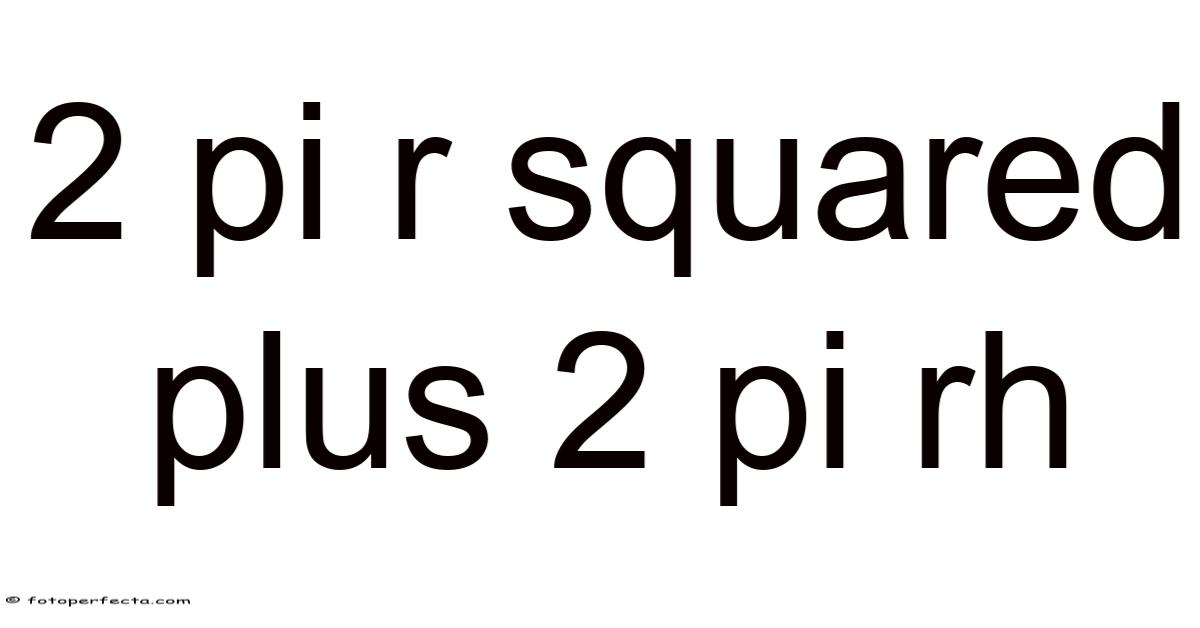
Understanding the Formula 2πr² + 2πrh: Surface Area of a Cylinder
The expression 2πr² + 2πrh is the classic formula for calculating the total surface area of a right circular cylinder, where r represents the radius of the circular bases and h denotes the height of the cylinder. This equation appears in countless textbooks, engineering manuals, and everyday problem‑solving situations—from designing water tanks to estimating paint requirements for cylindrical containers. Grasping not only how to use the formula but also why it works empowers students, hobbyists, and professionals to tackle a wide range of geometric challenges with confidence.
Introduction: Why Cylinder Surface Area Matters
Cylinders are one of the most common three‑dimensional shapes in both nature and industry. Think of soda cans, oil drums, pillars, and even certain biological structures such as plant stems. Whenever you need to know how much material will cover a cylindrical object—whether it’s metal sheet, fabric, or paint—you must determine its total surface area That's the part that actually makes a difference..
- The two circular bases (each with area πr²) → together they contribute 2πr².
- The curved lateral surface that wraps around the sides → its area is 2πrh.
Understanding each part separately helps demystify the overall equation and prevents common mistakes, such as forgetting to include the bases or mixing up radius and height.
Deriving the Formula Step by Step
1. Area of the Circular Bases
A circle’s area is given by A = πr². A right circular cylinder has two identical bases—one on the top and one on the bottom. Therefore:
[ \text{Base area total} = 2 \times πr² = 2πr² ]
2. Area of the Lateral Surface
Imagine “unrolling” the curved side of the cylinder into a flat rectangle. The rectangle’s height equals the cylinder’s height h, while its width equals the circumference of the base, which is 2πr. Multiplying width by height yields the lateral area:
[ \text{Lateral area} = (\text{circumference}) \times (\text{height}) = 2πr \times h = 2πrh ]
3. Combining Both Parts
Adding the base area and the lateral area gives the total surface area (SA):
[ \boxed{SA = 2πr² + 2πrh} ]
This compact expression captures the entire exterior of a right circular cylinder.
Practical Applications: When to Use the Formula
| Scenario | What You Need to Know | How the Formula Helps |
|---|---|---|
| Painting a metal drum | Radius of drum, height, paint coverage per square meter | Compute SA to estimate paint volume |
| Designing a water tank | Material cost per square meter, dimensions | Determine surface area → total material cost |
| Packaging design | Surface area for labeling or printing | Use SA to calculate label size or printing area |
| Thermal analysis | Heat transfer depends on exposed area | SA informs heat loss calculations |
| 3‑D modeling | Accurate mesh generation for rendering | SA assists in scaling textures correctly |
In each case, the same fundamental calculation—2πr² + 2πrh—provides the needed metric.
Step‑by‑Step Example: Calculating Surface Area
Problem: A cylindrical container has a radius of 7 cm and a height of 15 cm. Find its total surface area Worth keeping that in mind. That's the whole idea..
-
Identify the values:
- r = 7 cm
- h = 15 cm
-
Plug into the formula:
[ SA = 2πr² + 2πrh = 2π(7)² + 2π(7)(15) ]
-
Calculate each term:
- (2πr² = 2π \times 49 = 98π)
- (2πrh = 2π \times 7 \times 15 = 210π)
-
Add the terms:
[ SA = 98π + 210π = 308π ]
-
Convert to decimal (using π ≈ 3.1416):
[ SA ≈ 308 \times 3.1416 ≈ 967.6 \text{ cm}² ]
Result: The cylinder’s total surface area is approximately 968 cm².
Common Mistakes and How to Avoid Them
| Mistake | Why It Happens | Correct Approach |
|---|---|---|
| Omitting the factor 2 for the bases | Forgetting there are two circles | Remember: two bases → 2πr² |
| Using diameter instead of radius | Diameter is twice the radius, leading to a factor of 4 error | Always halve the diameter to obtain r |
| Mixing up height and radius | Similar symbols can cause confusion | Write down the given values and label them clearly before substitution |
| Applying the formula to a truncated cone | The shape differs; lateral area isn’t a simple rectangle | Use the appropriate formula for frustums or cones |
| Neglecting unit consistency | Mixing centimeters with meters yields wrong area | Convert all dimensions to the same unit before calculation |
By checking each step against this checklist, you can ensure accurate results every time It's one of those things that adds up..
Scientific Explanation: Why the Lateral Area Equals 2πrh
The lateral surface of a cylinder is a developable surface, meaning it can be flattened without stretching. When you cut the cylinder along a line parallel to its axis and lay it flat, you obtain a rectangle. Practically speaking, its height matches the cylinder’s height h. Because of that, the area of a rectangle is simply width × height, leading directly to 2πrh. The rectangle’s width is the distance traveled around the base—exactly the circumference 2πr. This geometric insight underlies many engineering simplifications, such as calculating material sheet requirements for rolled metal.
Frequently Asked Questions (FAQ)
Q1: Does the formula work for cylinders with elliptical bases?
No. The derivation assumes a circular base, where the circumference is 2πr. For an elliptical base, you would need the perimeter approximation of the ellipse and a different lateral area expression Not complicated — just consistent. Practical, not theoretical..
Q2: How does the formula change for a hollow cylinder (pipe) with thickness t?
You calculate the surface area of the outer cylinder using its outer radius R and height h, then add the surface area of the inner cylinder using inner radius r = R – t. The total external surface area (excluding the ends) is 2πRh + 2πrh; if the ends are also hollow, you subtract the inner base areas accordingly.
Q3: Can I use the formula for a cylinder lying on its side?
Yes. Surface area is independent of orientation; the same dimensions (r and h) give the same total area whether the cylinder stands upright or rests on its side.
Q4: What if the cylinder is not right‑angled (oblique cylinder)?
The lateral surface is no longer a perfect rectangle when unrolled. The formula becomes π(R + r)l, where l is the slant height. For a right cylinder, R = r and l = h, reducing to 2πrh.
Q5: How does the formula relate to volume?
While surface area uses πr² (area of a circle) and 2πrh (circumference × height), volume uses πr²h (base area × height). Both share the base area term, but surface area adds the contribution of the side wall It's one of those things that adds up..
Extending the Concept: Surface Area of Composite Shapes
Often, real‑world objects combine cylinders with other primitives—cones, spheres, or prisms. To find the total surface area of such a composite, follow these steps:
- Break the object into basic shapes (e.g., a cylinder topped with a cone).
- Calculate each component’s surface area using the appropriate formulas (cylinder: 2πr² + 2πrh, cone: πr√(r² + h²), etc.).
- Subtract any overlapping internal faces that are not exposed.
- Add the remaining external areas to obtain the overall surface area.
This modular approach leverages the familiar 2πr² + 2πrh formula as a building block for more complex designs That's the part that actually makes a difference..
Conclusion: Mastery Through Practice
The expression 2πr² + 2πrh elegantly captures the total exterior of a right circular cylinder by summing the areas of its two bases and its curved side. Understanding each term’s origin—πr² for a circle’s area and 2πr for a circumference—turns the formula from a memorized line into a logical, visualizable concept. Whether you are a student solving textbook problems, a DIY enthusiast estimating paint, or an engineer sizing a storage tank, mastering this formula equips you with a reliable tool for countless practical tasks Not complicated — just consistent. Simple as that..
Remember to:
- Verify that the shape is a right circular cylinder.
- Keep radius and height in the same units.
- Include both base areas (2πr²) and the lateral area (2πrh).
With these habits, you’ll avoid common pitfalls and achieve accurate, repeatable results. The next time you encounter a cylindrical object, you’ll instantly know how to compute its surface area—turning abstract symbols into concrete, useful knowledge Easy to understand, harder to ignore. Took long enough..
