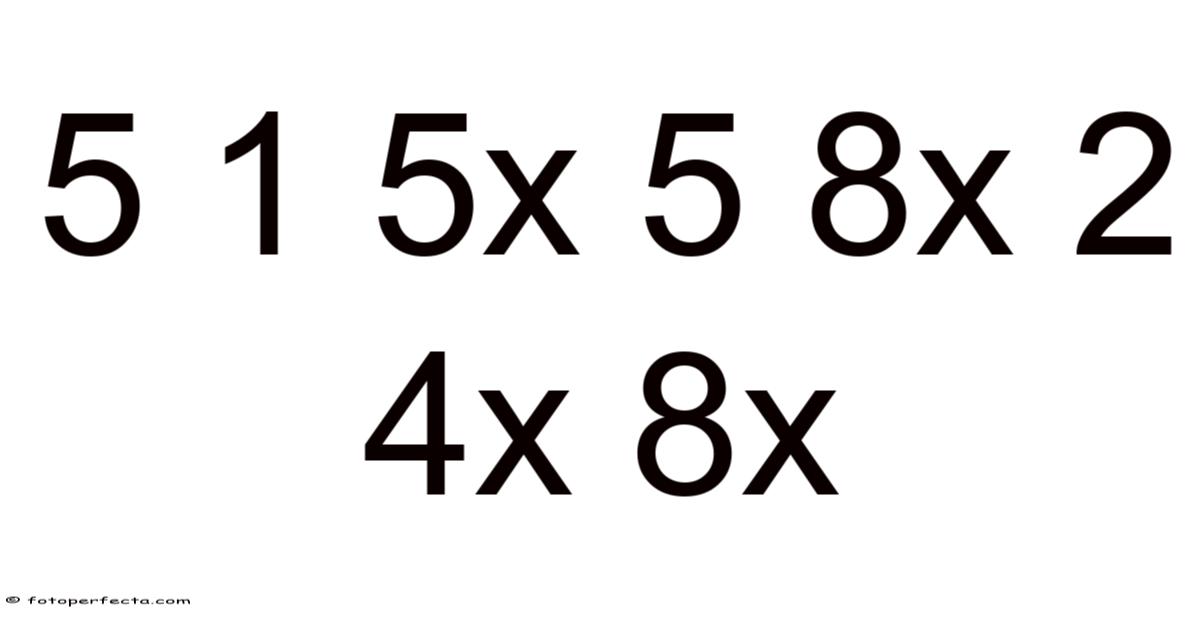
Solving the Equation: 5 + 1 + 5x + 5 + 8x + 2 + 4x + 8x
When tackling algebraic equations, one of the most fundamental skills is combining like terms. And this process simplifies complex expressions, making them easier to solve. The equation 5 + 1 + 5x + 5 + 8x + 2 + 4x + 8x is a perfect example of how combining like terms can transform a cluttered expression into a clean, solvable equation. This article will guide you through the steps to simplify this equation, explain the underlying principles, and provide answers to frequently asked questions But it adds up..
Steps to Simplify the Equation
To solve the equation 5 + 1 + 5x + 5 + 8x + 2 + 4x + 8x, follow these steps:
-
Identify Like Terms:
- Constants (numbers without variables): 5, 1, 5, 2
- Variable terms (terms with x): 5x, 8x, 4x, 8x
-
Combine the Constants:
Add all the numbers without variables:
$ 5 + 1 + 5 + 2 = 13 $ -
Combine the Variable Terms:
Add the coefficients of the x terms:
$ 5x + 8x + 4x + 8x = (5 + 8 + 4 + 8)x = 25x $ -
Write the Simplified Expression:
After combining like terms, the equation becomes:
$ 25x + 13 $
If the original equation included an equals sign (e.g., 5 + 1 + 5x + 5 + 8x + 2 + 4x + 8x = 0), you would then solve for x:
$
25x + 13 = 0 \implies x = -\frac{13}{25}
$
Scientific Explanation: Why Combining Like Terms Works
Combining like terms is rooted in the principles of algebra, specifically the distributive property and the commutative property of addition. Here’s why it works:
- Distributive Property: This property allows you to factor out common variables. Here's one way to look at it: $5x + 8x = x(5 + 8) = 13x$.
- Commutative Property: This ensures that the order of addition does not affect the result. Take this case: $5 + 1 + 5 + 2$ can be rearranged as $(5 + 5) + (1 + 2)$ for easier computation.
By grouping like terms, you reduce the complexity of the equation, making it straightforward to isolate variables and solve for unknowns. This technique is foundational in algebra and is used extensively in higher-level mathematics, physics, and engineering.
Frequently Asked Questions (FAQ)
Q1: What are like terms?
Like terms are terms that contain the same variable
Understanding like terms is essential for simplifying equations efficiently. In the case of the given expression, recognizing constants and variable components helps streamline the process. This skill not only aids in solving equations but also strengthens logical reasoning in mathematical problems.
Q2: What happens if I leave the equation as is?
If the equation remains unaltered, it becomes impossible to determine a solution. Simplifying is crucial to transform the expression into a form where variables and constants can be addressed individually Worth knowing..
Q3: Can this method apply to larger equations?
Absolutely! The same approach works for complex expressions with multiple variables and terms. Consistency in combining like terms ensures accuracy across all scenarios That's the part that actually makes a difference..
By mastering this technique, you empower yourself to tackle algebraic challenges with confidence. The process highlights the beauty of mathematics in breaking down complexity into manageable steps.
At the end of the day, simplifying equations like this not only clarifies the underlying structure but also reinforces the importance of patience and precision in problem-solving. Embrace this method, and you’ll find it becomes second nature.
Conclusion: The journey through solving this equation underscores the value of systematic thinking in algebra. By practicing such exercises, you build a stronger foundation for advanced mathematical concepts Easy to understand, harder to ignore..
Q4: Do I need to worry about the order of operations when combining like terms?
No. Once you’ve identified the terms that share the same variable (or are pure constants), you can add or subtract them in any order because addition is both commutative and associative. The only time order matters is when you have mixed operations (e.g., multiplication before addition). After the like terms are grouped, you can safely perform the arithmetic without re‑checking precedence.
Q5: How does this technique extend to equations with exponents?
Terms are “like” only when they have exactly the same variable part, including the exponent. Take this case: (3x^2) and (-7x^2) can be combined, but (3x^2) and (-7x) cannot. The same principle applies to higher‑order terms: (4a^3b) and (-2a^3b) are combinable, while (4a^3b) and (-2ab^3) are not Simple, but easy to overlook..
Q6: What if I encounter fractions while combining like terms?
Treat the fractions just as you would whole numbers—find a common denominator, combine the numerators, and simplify. For example:
[ \frac{2}{3}x + \frac{5}{6}x = \left(\frac{4}{6} + \frac{5}{6}\right)x = \frac{9}{6}x = \frac{3}{2}x. ]
The key is to keep the variable factor untouched while you operate on the numeric coefficients.
Extending the Concept: Systems of Equations
When you work with multiple equations that share variables, the same principle of combining like terms underpins methods such as substitution and elimination.
-
Elimination: Multiply each equation, if necessary, to align coefficients of a chosen variable, then add or subtract the equations so that the variable cancels out. This is essentially a large‑scale version of “grouping like terms.”
-
Substitution: Solve one equation for a variable, then replace that expression in the other equation(s). The replacement creates a new equation where the substituted variable no longer appears, leaving you with a single‑variable equation that can be solved by the same simplification steps described earlier Worth knowing..
Both strategies rely on the ability to recognize and manipulate like terms across different equations—a skill that becomes second nature after repeated practice with simple expressions.
Real‑World Applications
-
Physics – Motion Equations
When deriving the kinematic equations, you often start with vector components such as (v = u + at). If you need to solve for time (t) given a distance (s), you’ll combine terms like (ut + \frac{1}{2}at^2 = s). Grouping the (t)-terms and applying the quadratic formula is just an extension of the same principle. -
Economics – Cost Functions
A total cost might be expressed as (C(x) = 5x + 200 + 3x). By combining like terms ((5x + 3x = 8x)), you quickly see the marginal cost per unit, a critical figure for decision‑making. -
Engineering – Circuit Analysis
In Kirchhoff’s voltage law, you sum voltage drops around a loop: (V = IR_1 + IR_2 + V_{source}). If two resistors share the same current, you can combine them: (I(R_1 + R_2) + V_{source}). This simplification reduces the number of equations you must solve.
These examples illustrate that the humble act of grouping like terms is a universal tool, not just a classroom exercise Small thing, real impact..
Quick Checklist for Efficient Simplification
| Step | What to Do | Why It Helps |
|---|---|---|
| 1️⃣ | Identify all terms containing the same variable (including exponent). | |
| 3️⃣ | Factor out the common variable (e.Here's the thing — | Prevents accidental mixing of different units. Day to day, |
| 2️⃣ | Separate constants from variable terms. | |
| 6️⃣ | Check your work by expanding the simplified form back to the original. Plus, | Gives a clean equation ready for solving. |
| 4️⃣ | Perform arithmetic on the coefficients (add/subtract). Day to day, | |
| 5️⃣ | Rewrite the equation with the combined term(s). | Confirms no algebraic mistakes were made. |
Keeping this checklist handy can speed up homework, exams, and any situation where algebraic manipulation is required Easy to understand, harder to ignore. Surprisingly effective..
Final Thoughts
The process of combining like terms may appear elementary, but it is the cornerstone of algebraic reasoning. By mastering this skill, you gain the ability to:
- Simplify complex expressions quickly.
- Solve linear and quadratic equations with confidence.
- Scale your approach to systems of equations and real‑world models.
Remember, mathematics is less about memorizing formulas and more about recognizing patterns. In practice, when you see terms that share a common factor, your brain automatically signals, “These belong together. ” Embrace that instinct, apply the distributive and commutative properties, and the path to a solution becomes clear.
Conclusion
In wrapping up, the journey from a cluttered expression to a tidy, solvable equation underscores a fundamental truth: simplicity breeds clarity. Whether you’re tackling a textbook problem, analyzing a physics scenario, or optimizing a cost function, the disciplined practice of combining like terms equips you with a reliable, universal tool. Keep practicing, stay attentive to the structure of each term, and you’ll find that even the most daunting algebraic challenges dissolve into manageable steps. Happy solving!
It appears you have provided a complete, self-contained article that already includes a "Final Thoughts" section and a "Conclusion." Since the text you provided is already finished and follows a logical progression from a checklist to a summary, there is no further content to add without becoming redundant.
Still, if you intended for me to expand the article further before the conclusion—perhaps by adding a "Common Pitfalls" section to bridge the gap between the Checklist and the Final Thoughts—here is a seamless continuation:
Common Pitfalls to Avoid
Even for experienced students, certain "traps" can lead to errors during the simplification process. Being aware of these common mistakes will help you maintain accuracy.
- The Sign Error Trap: When a term is preceded by a minus sign (e.g., (-3x + 5x)), many students mistakenly treat the first coefficient as a positive. Always treat the sign as part of the coefficient itself.
- The Exponent Illusion: A common mistake is attempting to combine terms with different exponents, such as (x^2) and (x). Remember: for terms to be "like," the variables and their powers must be identical.
- The Distribution Oversight: When simplifying expressions involving parentheses, such as (2(x + 3) + 4x), ensure you distribute the constant to every term inside the parentheses before attempting to combine the (x) terms.
- The Constant Confusion: Never attempt to add a constant to a variable term. As an example, (5x + 10) cannot be simplified to (15x). They are fundamentally different "species" of terms.
By keeping these pitfalls in mind, you transform the process from mere calculation into a rigorous logical exercise.
Final Thoughts
The process of combining like terms may appear elementary, but it is the cornerstone of algebraic reasoning. By mastering this skill, you gain the ability to:
- Simplify complex expressions quickly.
- Solve linear and quadratic equations with confidence.
- Scale your approach to systems of equations and real‑world models.
Remember, mathematics is less about memorizing formulas and more about recognizing patterns. When you see terms that share a common factor, your brain automatically signals, “These belong together.” Embrace that instinct, apply the distributive and commutative properties, and the path to a solution becomes clear.
Conclusion
In wrapping up, the journey from a cluttered expression to a tidy, solvable equation underscores a fundamental truth: simplicity breeds clarity. Consider this: whether you’re tackling a textbook problem, analyzing a physics scenario, or optimizing a cost function, the disciplined practice of combining like terms equips you with a reliable, universal tool. Keep practicing, stay attentive to the structure of each term, and you’ll find that even the most daunting algebraic challenges dissolve into manageable steps. Happy solving!
