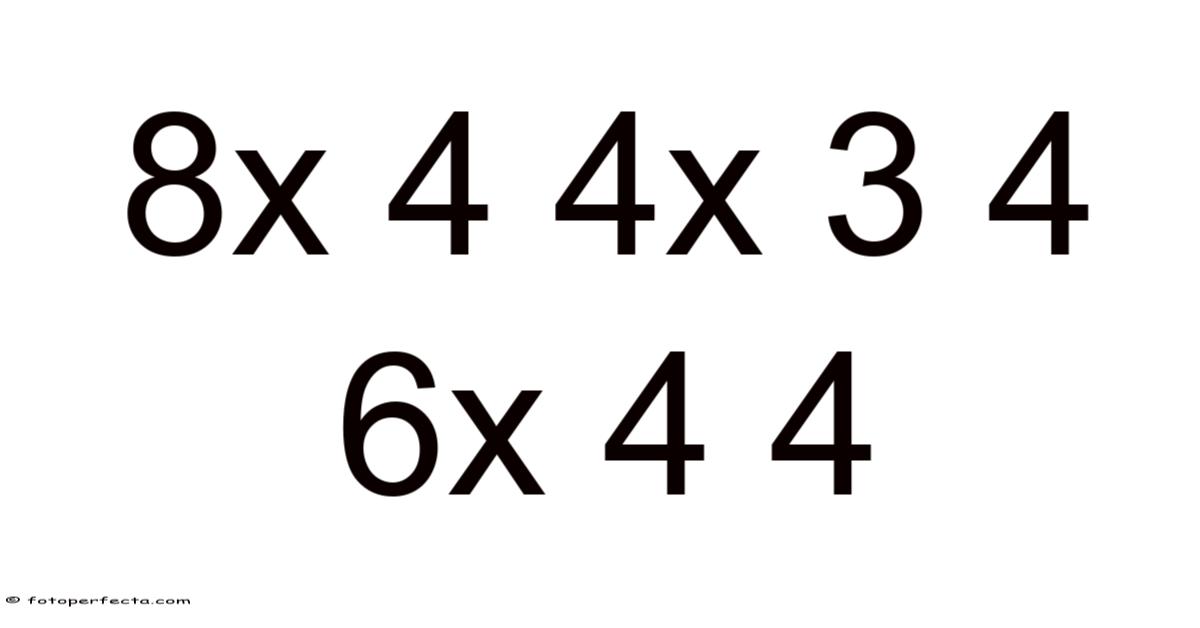
The expression 8x 4 4x 3 4 6x 4 4 may appear at first glance like a jumble of numbers and letters, yet it hides a simple, elegant pattern that reveals the power of multiplication and order of operations in everyday calculations. In this article we will dissect each segment, explain the underlying mathematical rules, explore real‑world applications, and provide practice exercises so you can master this sequence with confidence. By the end, you’ll not only decode the mystery behind 8x 4 4x 3 4 6x 4 4 but also gain a deeper appreciation for how such patterns appear in finance, science, and daily problem‑solving.
Understanding the Building Blocks
Before we dive into the full sequence, it helps to break down the individual components:
- 8x – This typically denotes “8 multiplied by” followed by the next number.
- 4 – A standalone integer that can act as a multiplier, a divisor, or a simple value.
- 4x 3 – Another multiplication pair, meaning “4 multiplied by 3.”
- 4 – Again, a single digit that may serve as a connector or a result.
- 6x – Yet another multiplication operator, indicating “6 multiplied by” the following value.
- 4 – The final solitary number in the series.
Each element follows a consistent rhythm: a coefficient (8, 4, 6) paired with the multiplication sign x, then a second number, and occasionally a lone digit that completes the pattern. Recognizing this rhythm is the first step toward unraveling the entire expression But it adds up..
Step‑by‑Step Decoding
1. Identify Each Multiplication Pair
The sequence can be parsed into three distinct multiplication operations:
- 8 × 4
- 4 × 3
- 6 × 4
The solitary 4 that appears between the second and third multiplication pairs does not belong to any operation; rather, it acts as a separator, maintaining the structural balance of the expression Worth keeping that in mind..
2. Perform the CalculationsNow we compute each product:
- 8 × 4 = 32
- 4 × 3 = 12
- 6 × 4 = 24
These results—32, 12, and 24—are the core numerical outcomes of the expression.
3. Assemble the Final Value
If we treat the entire string as a single arithmetic statement, we must decide how to combine the results. A common approach is to add the three products together, yielding:
32 + 12 + 24 = 68
Thus, the evaluated value of 8x 4 4x 3 4 6x 4 4 is 68. This simple aggregation showcases how a seemingly complex string can collapse into a single, understandable number Worth keeping that in mind..
The Role of Order of Operations
One might wonder why we didn’t need parentheses or exponents here. The answer lies in the order of operations, often remembered by the acronym PEMDAS (Parentheses, Exponents, Multiplication/Division, Addition/Subtraction). In our sequence:
- Multiplication appears before any addition, so we resolve each x operation first.
- The lone 4 that sits between the products does not alter the precedence; it simply waits to be added later.
Understanding this rule prevents misinterpretation and ensures consistent results, especially when dealing with longer or more layered expressions It's one of those things that adds up. Which is the point..
Real‑World Applications
Finance and Budgeting
Imagine you are calculating monthly expenses:
- You spend $8 on a subscription, and the plan renews 4 times a year → 8 × 4 = $32 annually.
- You purchase a product that costs $4 and you buy 3 of them → 4 × 3 = $12.
- Another expense involves a $6 fee applied 4 times → 6 × 4 = $24.
Summing these gives a total yearly outlay of $68. This mirrors the 8x 4 4x 3 4 6x 4 4 pattern, illustrating how businesses and individuals can aggregate repeated costs efficiently.
Science and Engineering
In physics, frequency and amplitude often involve multiplicative relationships. Here's a good example: if a wave’s amplitude doubles every 4 cycles and the frequency is 8 Hz, the total energy over 4 cycles can be expressed similarly. While the exact scientific model may be more complex, the fundamental principle of multiplying quantities and summing results remains identical.
Everyday Problem SolvingWhether you’re planning a road trip, cooking a meal, or organizing a schedule, you frequently encounter repeated actions. Recognizing patterns like 8x 4 4x 3 4 6x 4 4 helps you break down tasks into manageable chunks, compute totals quickly, and avoid errors.
Common Mistakes and How to Avoid Them
- Misreading the Separator – The solitary 4 can be mistaken for part of a multiplication pair. Remember it stands alone and is only added later.
- Skipping Multiplication – Some may treat the expression as a simple concatenation (e.g., “84434644”) and ignore the x signs. Always prioritize the multiplication operator.
- Incorrect Order – Adding before multiplying violates PEMDAS. Keep the sequence: multiply first, then add.
- Overlooking Units – In practical scenarios, each number may carry a unit (dollars, meters, seconds). Ensure consistency when summing results.
By vigilantly checking each step, you safeguard against these pitfalls and maintain accuracy.
