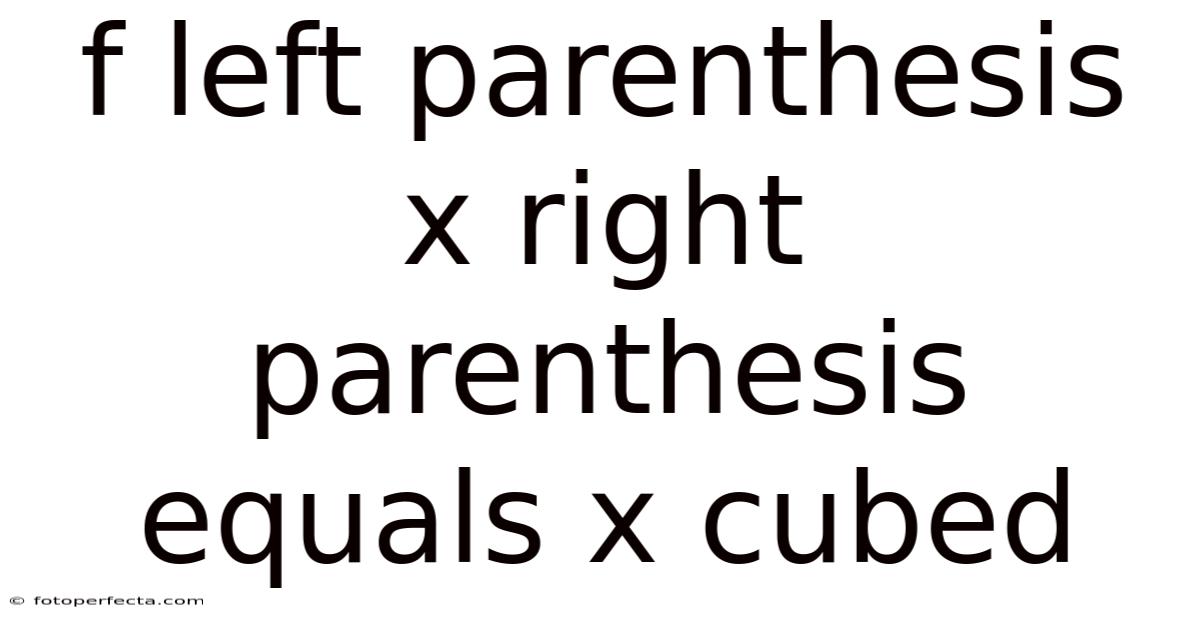
Understanding the mathematical concept of left parenthesis multiplied by right parenthesis equals x cubed is essential for students and learners who are diving into algebra. This simple yet powerful idea forms the foundation of many mathematical operations and helps clarify how expressions transform when manipulated. In this article, we will explore what this equation means, why it matters, and how it applies in real-world scenarios.
When we encounter the expression (x × x × x), it becomes clear that we are dealing with a cube. The multiplication inside the parentheses is not just a random arrangement—it is a way to calculate a specific value based on the value of x. The left parenthesis and the right parenthesis work together to define the operation we are performing. This process is crucial for solving equations and understanding how variables interact in mathematical models Which is the point..
Let’s break down the concept further. That's why finally, we multiply 8 by 2 to get 16. The expression (x × x × x) is equivalent to raising x to the power of 3. So first, we multiply 2 by 2, which gives us 4. Then, we multiply 4 by 2 again, resulting in 8. So, the value of the expression is 16. On the flip side, this means that we take the value of x, multiply it by itself twice, and then by itself once more. That's why for example, if x equals 2, then the calculation would look like this: (2 × 2 × 2). This demonstrates how the left parenthesis and right parenthesis guide us through the steps of multiplication and exponentiation.
Understanding this operation is not just about performing calculations—it’s about grasping the logic behind how mathematical expressions evolve. When we see x in a cube-like structure, it reminds us of the importance of consistency in operations. Each multiplication step must be carried out carefully to ensure accuracy. This process reinforces the value of precision in learning and applying mathematics Still holds up..
In practical terms, this concept is widely used in various fields. Worth adding: whether you are working on a science project, a math homework assignment, or even a business calculation, the ability to manipulate expressions like this is invaluable. As an example, in physics, scientists often use such formulas to describe relationships between variables. In finance, investors might calculate returns based on compound interest, which relies on similar mathematical principles. By mastering this idea, learners can build a stronger foundation for more advanced topics.
The importance of this equation extends beyond numbers. It teaches us about the power of patterns and repetition. That's why when we see the same operation repeated, we learn to recognize the underlying structure. This skill is essential in problem-solving, where breaking down complex ideas into simpler components is key. By understanding how left parentheses and multiplication interact, students can develop a deeper appreciation for the beauty of mathematics Not complicated — just consistent..
Also worth noting, this concept highlights the significance of order of operations. Without proper attention to the sequence of operations, even small mistakes can lead to incorrect results. In mathematics, the order in which we perform calculations matters. That's why this is why it’s crucial to follow guidelines, such as multiplying from left to right when dealing with multiple operations. By doing so, learners check that their calculations are reliable and meaningful That's the whole idea..
Another aspect to consider is how this idea applies to real-life situations. Imagine you are calculating the volume of a cube-shaped container. Practically speaking, if the side length of the cube is represented by x, then the volume would be x cubed. This is a direct application of the expression (x × x × x). In real terms, whether you are designing a product, analyzing data, or solving a puzzle, this formula provides a clear path forward. It shows how abstract mathematical concepts can have tangible impacts in everyday life.
To further clarify, let’s explore some examples. In practice, then, we multiply 9 by 3 again, resulting in 27. Finally, we multiply 27 by 3 to get 81. This demonstrates how the operation progresses step by step. Similarly, if x is 5, the result is (5 × 5 × 5), which equals 125. If x equals 3, the calculation becomes (3 × 3 × 3). First, we multiply 3 by 3, which equals 9. These examples reinforce the idea that the left parenthesis and right parenthesis dictate the flow of operations Took long enough..
It’s also worth noting how this concept connects to other mathematical principles. By understanding how to manipulate expressions like this, learners can better grasp more complex topics such as functions, graphs, and even calculus derivatives. On top of that, the idea of raising a number to a power is closely related to exponents, which are fundamental in algebra and calculus. This connection highlights the interconnected nature of mathematical knowledge.
When studying this topic, it’s important to pay attention to the symbols and their meanings. Left parenthesis and right parenthesis are not just symbols—they represent a specific action. They signal the beginning and end of a sequence of operations. This clarity helps prevent confusion and ensures that calculations are executed correctly. For students, recognizing these symbols as indicators of action is a vital skill That's the part that actually makes a difference..
In addition to mathematical applications, this concept fosters critical thinking. It encourages learners to think about the relationships between different elements in an equation. By analyzing how each part of the expression contributes to the final result, students develop a stronger analytical mindset. Even so, this skill is not only useful in academics but also in everyday decision-making. Understanding how small changes affect outcomes can empower individuals to approach challenges with confidence The details matter here..
Short version: it depends. Long version — keep reading.
The learning process doesn’t stop once you grasp the basic idea. Practicing with different values of x is essential. Try substituting various numbers into the equation and observe the results. This hands-on approach reinforces understanding and builds confidence. To give you an idea, if you test x = 1, the expression becomes (1 × 1 × 1), which equals 1. If x = 0, the result is 0, and for x = -2, it becomes (-2 × -2 × -2), which equals -8. These variations illustrate how the operation changes with different inputs, making the concept more intuitive That's the part that actually makes a difference..
Also worth noting, this principle applies beyond simple numbers. Consider this: understanding how operations transform values is crucial for writing effective algorithms. In programming and coding, similar logic is used to process data. This connection between mathematics and technology shows the relevance of these concepts in modern contexts.
As learners progress, they may encounter more complex versions of this idea. Which means for example, expressions like (x + 1)³ or (a × b) × c require careful attention to the order of operations. On the flip side, the core idea remains the same: using parentheses to guide the calculation ensures accuracy. This consistency is what makes mathematics a reliable tool for problem-solving.
So, to summarize, the equation (x × x × x) equals x cubed is more than just a formula—it’s a stepping stone toward mastering advanced mathematical concepts. By understanding this relationship, students can build a solid foundation for future learning. Whether in school, work, or personal projects, this knowledge empowers individuals to tackle challenges with clarity and precision.
Remember, the power of mathematics lies in its simplicity when applied correctly. Each operation, whether it’s a multiplication inside parentheses or a cube calculation, plays a vital role in shaping our understanding. By embracing these principles, learners can transform their approach to learning and achieve greater success in their academic and professional journeys.
