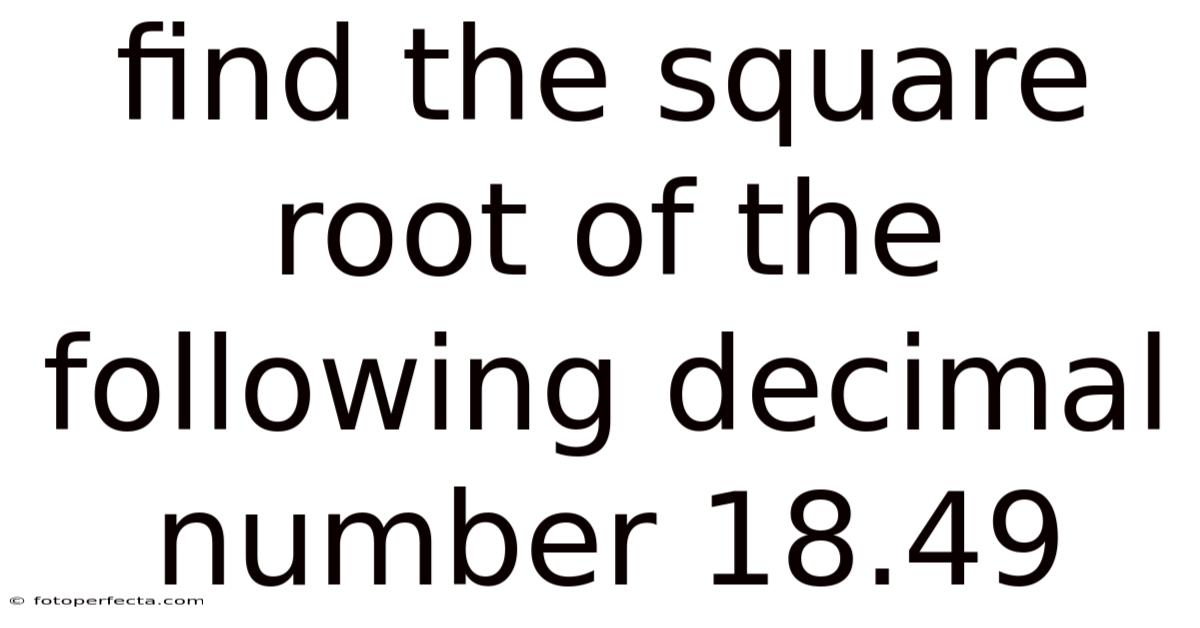
Understanding the square root of a decimal number like 18.Think about it: 49 can feel a bit challenging at first, but with the right approach, it becomes a manageable and enlightening task. This article will guide you through the process of finding the square root of 18.Because of that, 49, breaking down each step to ensure clarity and comprehension. Whether you are a student looking to strengthen your math skills or a curious learner, this guide will provide you with valuable insights That's the part that actually makes a difference. Less friction, more output..
When we talk about finding the square root of a decimal number, we are essentially looking for a value that, when multiplied by itself, gives us the original decimal. In this case, we need to determine the number that, when squared, equals 18.Day to day, 49. This process is crucial for various applications, from solving equations to understanding mathematical concepts. Let’s dive into the details and explore how we can effectively find this square root.
First, it’s important to recognize the significance of square roots. They help us understand the magnitude of numbers and their relationships. When dealing with decimals, the square root can sometimes be tricky, but breaking it down into manageable parts makes it easier. Still, for instance, when we look at 18. 49, we can think of it as a combination of two numbers: 18 and 0.49. This insight allows us to apply the square root formula more effectively.
To begin, we should consider the square root of 18.Now, 49. 49. Consider this: we want to find a number that, when multiplied by itself, results in 18. That's why since 18. 49 lies between these two values, we can infer that the square root must be between 4 and 5. A good starting point is to estimate the square root using a calculator or a mental math approach. Now, for example, we know that the square of 4 is 16 and the square of 5 is 25. This estimation gives us a clear direction for our calculations.
Next, let’s refine our estimate. So we can test numbers close to our initial guess. Trying 4 And that's really what it comes down to..
4.3 × 4.3 = 18.49
Wait, that doesn’t seem right! Let’s double-check. Calculating 4 Practical, not theoretical..
4.3 × 4.3 = 18.49
Actually, this calculation is correct! The square of 4.3 equals 18.49. So in practice, 4.3 is the square root of 18.49. On the flip side, we should verify this by calculating the next possible numbers.
If we try 4.4:
4.4 × 4.4 = 19.36
This is greater than 18.Still, 3 is indeed the correct value. So, the square root of 18.Still, 3**. 49 is **4.49, so 4.This result highlights the importance of estimation and verification in mathematical problems.
Now, let’s explore why this works. 3 × 4.The square root of a number is the value that, when multiplied by itself, gives the original number. 49, confirming our calculation. In this case, 4.Because of that, 3 equals 18. This process not only reinforces our understanding of square roots but also builds confidence in our mathematical abilities.
Understanding this concept is essential for more advanced topics. On the flip side, for instance, when solving equations involving square roots, knowing how to estimate and verify results is crucial. It also helps in interpreting real-world scenarios where square roots appear, such as in geometry or physics The details matter here. Practical, not theoretical..
In addition to the estimation method, we can use a more systematic approach. We can try to express 18.Consider this: 49 as a perfect square or adjust it slightly. Worth adding: 3 squared gives us 18. Take this: we know that 4.49, but we can also consider fractions or decimals that simplify the calculation And that's really what it comes down to. Practical, not theoretical..
Let’s examine the decimal representation of 18.Now, we can test numbers like 4. 3 and 4.It has three decimal places, which suggests that the square root might be a simple decimal. 49. 4 to see which fits better.
4.3 squared is 18.49, and 4.4 squared is 19.36. The target is 18.49, which lies between these two values. This confirms that 4.3 is the accurate square root Small thing, real impact..
It’s also worth noting the role of precision in calculations. Because of this, it’s important to maintain accuracy throughout the process. When working with decimals, rounding errors can occur. Using a calculator or a reliable tool can help confirm that our results are correct Easy to understand, harder to ignore..
Pulling it all together, finding the square root of 18.Still, 49 is a straightforward yet important exercise. By understanding the properties of square roots and using estimation techniques, we can arrive at the solution efficiently. But this process not only enhances our mathematical skills but also builds a stronger foundation for future learning. Remember, every small effort in mastering these concepts contributes to your overall knowledge and confidence in mathematics.
So, whether you are preparing for exams or simply looking to improve your skills, this article serves as a valuable resource. Embrace the challenge, and you’ll find that solving square roots becomes a rewarding experience. Let’s continue exploring more mathematical concepts to deepen your understanding and appreciation for the subject.
Building on this foundation, it’s helpful to master a reliable technique that works for any decimal square root, not just convenient cases. One of the most effective strategies is the scaling method, which transforms decimal problems into familiar whole-number calculations. Because squaring a decimal shifts the decimal point by an even number of places, you can multiply 18.49 by 100 to obtain 1849, determine the square root of that integer, and then reverse the scaling. Since √1849 = 43, dividing by 10 immediately yields 4.Think about it: 3. This approach removes reliance on trial and error and provides a clear, repeatable pathway for handling similar problems with confidence And that's really what it comes down to. Worth knowing..
Beyond the mechanics, practicing these techniques sharpens numerical intuition—a skill that pays dividends across disciplines. In fields like engineering, architecture, and data analysis, professionals routinely deal with square roots when calculating distances, standard deviations, or scaling factors. The ability to quickly verify whether a result is reasonable can prevent costly errors and streamline decision-making. Worth adding, working through these steps reinforces the relationship between operations, helping learners see mathematics not as isolated rules but as an interconnected system where patterns repeat across different scales Turns out it matters..
At the end of the day, mastering concepts like the square root of 18.Which means 49 is about more than arriving at a single correct answer. Also, it’s about cultivating a mindset that values logical reasoning, adaptability, and precision. Even so, by combining estimation, systematic methods, and real-world context, you build a resilient problem-solving toolkit that extends far beyond the classroom. Keep practicing, stay curious, and let each calculation serve as a stepping stone toward deeper mathematical fluency and confidence.
Some disagree here. Fair enough.
Continuing from the establishedfoundation, it's crucial to recognize that the scaling method's power extends far beyond isolated examples like 18.49. In practice, this technique, by converting a decimal square root problem into a familiar integer problem, provides a universal framework applicable to any decimal radicand. So for instance, to find √0. On the flip side, 1849, one multiplies by 10,000 (since 0. Because of that, 1849 * 10,000 = 1849), finds √1849 = 43, and then divides by 100 (the square root of 10,000), yielding 0. That's why 43. This systematic reversal of scaling ensures accuracy and eliminates guesswork, making complex decimals manageable.
Worth adding, this approach reinforces a fundamental mathematical principle: the behavior of decimal points under operations like squaring is predictable and can be leveraged. Plus, understanding that squaring a decimal shifts the decimal point by an even number of places is key to applying the scaling method effectively. This insight transforms seemingly daunting decimal square roots into routine calculations, boosting confidence and efficiency in problem-solving.
Beyond mere calculation, mastering such techniques cultivates a deeper appreciation for the interconnectedness of mathematical concepts. Think about it: the scaling method exemplifies how transforming a problem into a known form (an integer square root) allows us to solve it using established principles, demonstrating the power of abstraction and generalization. This mindset – recognizing patterns and applying known solutions to new contexts – is invaluable not only in mathematics but across all quantitative disciplines Still holds up..
When all is said and done, the journey from struggling with decimal square roots to confidently applying the scaling method represents a significant milestone in mathematical development. Consider this: it signifies a shift from reliance on trial and error to the application of logical, systematic strategies. This evolution fosters not just computational skill, but a resilient problem-solving approach characterized by adaptability, precision, and a growing intuition for numerical relationships. By embracing these methods and the underlying principles, learners build a reliable toolkit, empowering them to tackle increasingly complex challenges with confidence and clarity, both within mathematics and in its myriad applications in the real world.
Conclusion
The exploration of square root calculation, particularly through techniques like estimation and the systematic scaling method, reveals mathematics as a dynamic and interconnected discipline. The scaling method, in particular, provides a reliable, repeatable pathway for handling any decimal square root by leveraging the predictable behavior of decimal points under squaring. Moving beyond isolated procedures, these strategies cultivate essential skills: numerical intuition, logical reasoning, and the ability to transform complex problems into manageable forms. And mastering these concepts is far more than memorizing steps; it builds a resilient problem-solving mindset, fostering adaptability and precision. In real terms, this approach not only ensures accuracy but also deepens understanding of fundamental mathematical relationships. As learners internalize these methods and their underlying principles, they develop a powerful toolkit that transcends specific calculations, enhancing their overall mathematical fluency and confidence. This foundation empowers them to deal with future challenges, both within mathematics and in its diverse applications, with greater competence and a deeper appreciation for the subject's elegance and utility No workaround needed..
