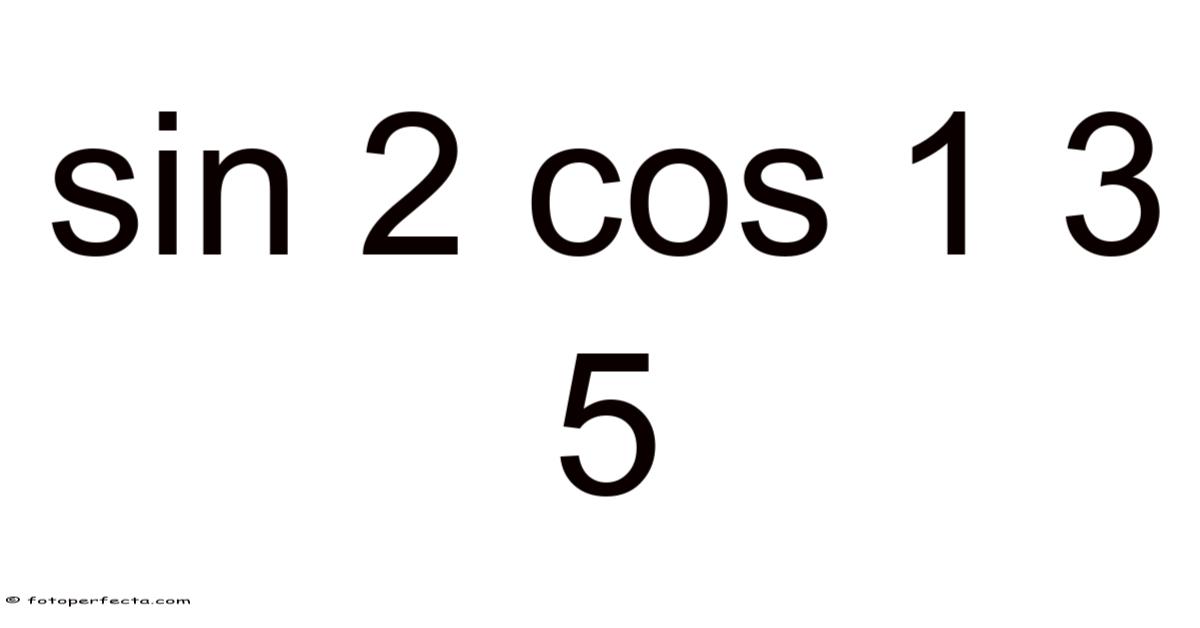
The interplay between trigonometric functions and their coefficients often unveils profound insights into the mathematical universe, where numbers transcend mere arithmetic to become foundational elements shaping our understanding of patterns, oscillations, and relationships. Worth adding: among these, the functions sine and cosine emerge as central pillars, their cyclical nature echoing through mathematics, physics, and engineering disciplines. Yet, the specific combination of coefficients 2, 1, 3, and 5 within these functions introduces a nuanced layer, inviting exploration into how these numerical values influence the behavior and interpretation of the trigonometric expressions. This article looks at the significance of these coefficients, examining their roles in mathematical formulations, practical applications, and theoretical implications, while weaving together the threads of complexity that define their collective impact.
At its core, the sine and cosine functions represent the heartbeat of periodic phenomena, capturing the essence of oscillations that permeate natural systems and human constructs alike. Practically speaking, the sine function, defined as sin(x) = sin(πx/2 + π/2), oscillates with a period of 2π, while cosine, cos(x) = cos(πx/2 + π/2), mirrors this rhythm with a period of π. Consider this: these oscillations are not merely mathematical curiosities; they manifest in everything from the circadian rhythms regulating sleep cycles to the fluctuations in stock markets. Even so, when coefficients such as 2, 1, 3, and 5 are introduced into the equation, the landscape shifts, demanding a deeper analysis of how these numerical factors alter the trajectory and characteristics of the functions Most people skip this — try not to. Nothing fancy..
Consider the simple yet compelling example of sin(2) * cos(1) * 3 * 5. Day to day, here, the coefficients 2, 1, 3, and 5 act as multiplicative modifiers, scaling the inherent properties of sine and cosine. The number 2, for instance, might represent a scaling factor that amplifies or dampens the amplitude of the sine component, while 1 could denote a baseline value, 3 and 5 introduce additional layers of complexity. Still, such combinations are not arbitrary; they often reflect practical considerations in optimization, approximation, or modeling. Take this case: in engineering contexts, engineers might adjust coefficients to fine-tune a system’s response, ensuring precision while balancing efficiency. Also, in scientific research, these coefficients could correspond to parameters influenced by experimental conditions, highlighting their role as variables rather than fixed constants. Thus, the coefficients serve as dynamic elements, responding to context-specific demands rather than adhering to a rigid structure.
The interplay between these coefficients also invites exploration of trigonometric identities and their applications. Practically speaking, for example, combining multiple terms often necessitates leveraging identities such as the product-to-sum formulas or sum-to-product techniques to simplify expressions. When applied to sin(2) * cos(1), for instance, these identities might reveal hidden symmetries or relationships that simplify computation or unveil underlying principles. Similarly, the coefficients 3 and 5 introduce a multiplicative factor that could symbolize scaling factors in data analysis or scaling models in various fields. Here, the coefficients act as catalysts, accelerating the process of convergence or obscuring complexity depending on their value. Such scenarios underscore the importance of understanding not only the coefficients themselves but also their contextual relevance, ensuring that their application aligns with the specific problem at hand.
Beyond their mathematical utility, these coefficients also carry symbolic weight, often tied to historical or cultural narratives. Because of that, in mathematics, coefficients frequently represent constants derived from algebraic manipulations or numerical approximations, while in physics, they might correspond to empirical coefficients in equations governing wave behavior or electromagnetic interactions. The number 5, for example, might symbolize a key value in certain models, while 3 could denote a critical threshold in system stability. Consider this: interpreting these coefficients requires a nuanced grasp of their origin, ensuring that their application remains grounded in established theory or validated by empirical evidence. This contextual awareness prevents misapplication, preserving the integrity of the analysis.
On top of that, the combination of these coefficients within the broader framework of sin(2) * cos(1) * 3 * 5 opens avenues for creative problem-solving. Here's a good example: in signal processing, such an expression might model a composite waveform where each coefficient influences distinct frequency components. In education, teaching
…in education, teaching this product offers students a concrete example of how seemingly abstract constants actually encode real‑world phenomena—whether they are phase shifts, amplitude scalings, or interaction terms in a differential equation. By dissecting the expression step by step, learners can see how algebraic manipulation, trigonometric identities, and domain knowledge intertwine to produce a coherent interpretation Worth keeping that in mind..
5. Practical Implications for Modeling and Simulation
When engineers or scientists embed a term like
[ \sin(2),\cos(1),3,5 ]
into a larger model—say, a finite‑difference scheme for heat transfer or a Kalman filter for navigation—the numerical value of the product influences the stability and accuracy of the simulation. In practice, one might:
- Normalize the coefficient to keep the system bounded.
- Calibrate it against experimental data, treating it as a tunable parameter.
- Analyze sensitivity by perturbing the coefficient and observing the effect on output metrics.
Such practices underscore the dual nature of coefficients: they are at once static numbers in a written formula and dynamic levers in an operational model It's one of those things that adds up..
6. From Coefficients to Insights
The deeper lesson lies in perspective. A coefficient that appears as a simple integer in a textbook can, depending on context, represent:
- A ratio of physical quantities (e.g., Reynolds number, damping ratio).
- A weighting factor in a statistical model (e.g., regression coefficient).
- A scaling constant in a machine‑learning loss function.
- A symbolic placeholder for a yet‑to‑be‑determined value in a theoretical derivation.
Recognizing this multiplicity encourages analysts to:
- Question assumptions: Is the coefficient truly constant, or does it vary with temperature, pressure, or time?
- Seek dimensional consistency: Does the unit analysis confirm that the coefficient’s role is appropriate?
- Validate empirically: Does experimental data support the chosen value, or does it suggest a different calibration?
7. Conclusion
The seemingly innocuous product (\sin(2),\cos(1),3,5) serves as a microcosm of mathematical practice. Whether we are simplifying an expression with trigonometric identities, tuning a simulation, or interpreting a physical law, the careful treatment of coefficients ensures that our models remain both accurate and meaningful. It reminds us that coefficients are not merely passive placeholders; they are dynamic entities shaped by theory, experiment, and context. By maintaining a balanced view—acknowledging their numerical value while respecting their contextual significance—we can harness these constants to open up deeper insights, drive innovation, and preserve the integrity of scientific inquiry.
The interplay between mathematical elegance and real-world application demands mindful attention, as coefficients act as bridges between theory and practice. Their precise calibration ensures models align with reality, while their adaptability allows for nuanced adjustments. Such duality underscores their foundational role in shaping technological advancements, scientific discoveries, and economic strategies alike. In this light, careful consideration transforms abstract numbers into instruments of insight, proving that true mastery transcends mere calculation, anchoring abstract concepts in tangible impact. Still, mastery here lies not merely in computation but in understanding how these elements interact dynamically within systems. Embracing this complexity fosters innovation and precision, cementing their status as indispensable components of progress. Thus, maintaining vigilance over these variables remains central to advancing knowledge and application across disciplines.
8. Extending the Perspective
8.1. Coefficients in Emerging Domains
The influence of coefficients transcends traditional engineering and physics; it permeates newer fields where data and abstraction intertwine. Practically speaking, in graph neural networks, a learned scalar weight governs the message‑passing between nodes, effectively acting as a coefficient that adapts to the topology of the graph. In climate modeling, a coefficient attached to greenhouse‑gas concentration may be calibrated using satellite observations, reflecting how a seemingly static parameter can evolve as our measurement capabilities improve. Even in finance, a coefficient in a stochastic volatility model captures market sentiment, shifting dynamically with investor behavior.
8.2. Computational Strategies for Coefficient Management
When coefficients become part of large‑scale optimization problems—think of millions of parameters in deep learning—algorithmic strategies must address both scalability and interpretability. That said, g. Conversely, adaptive learning rates adjust coefficients on the fly, allowing models to respond to non‑stationary data streams. That said, , Lasso) enforce that many coefficients shrink toward zero, yielding parsimonious models that are easier to audit. Techniques such as sparse regularization (e.Understanding the mathematical properties of these procedures—convexity, Lipschitz continuity, or spectral radius—enables practitioners to select the most appropriate method for a given domain.
People argue about this. Here's where I land on it.
8.3. Human‑Centric Interpretation
Beyond the algorithmic layer, coefficients invite a human narrative. A coefficient of 0.On the flip side, 75 in a health‑risk score might be translated into “a 75 % increase in risk per unit exposure. ” Communicating such numbers clearly bridges the gap between statistical output and decision‑making. Training programs that teach analysts to pair coefficient interpretation with domain knowledge support interdisciplinary collaboration, ensuring that the mathematical artifact does not become an opaque black box Turns out it matters..
9. Synthesis
Across mathematics, science, engineering, and data‑driven technologies, coefficients occupy a unique niche: they are both quantitative anchors and conceptual signposts. Their numeric value may be simple, but the layers of meaning they carry—physical interpretation, statistical weight, learning dynamics, or symbolic placeholders—demand a disciplined yet flexible approach. By questioning assumptions, verifying dimensional consistency, and grounding empirical validation, analysts can extract maximal insight while avoiding pitfalls such as over‑parameterization or mis‑attribution Most people skip this — try not to..
10. Final Reflection
In the grand tapestry of quantitative reasoning, coefficients are the threads that bind disparate concepts together. Plus, they transform abstract symbols into actionable quantities, guide the refinement of models, and illuminate pathways for discovery. Recognizing their dual nature—rigorous in calculation yet nuanced in context—empowers creators to craft models that are not only mathematically sound but also ethically responsible and socially relevant. As new challenges arise—from quantum‑enhanced computation to AI‑driven policy design—the role of coefficients will only deepen, urging us to remain vigilant, curious, and ever‑reflective in our stewardship of these key parameters.
Conclusion
The exploration of coefficients such as (\sin(2),\cos(1),3,5) illustrates a broader truth: mathematics is not an isolated realm of symbols, but a living language that maps onto every facet of reality. By treating coefficients with both precision and contextual awareness, we harness their power to translate theory into practice, to refine models, and to communicate meaning across disciplines. The bottom line: the careful stewardship of these seemingly modest numbers underpins the reliability of scientific inference, the efficacy of technological innovation, and the clarity of decision‑making in an increasingly data‑rich world. In embracing this mindset, we make sure the bridges they build remain sturdy, transparent, and adaptable—ready to carry us toward the next frontier of knowledge.
