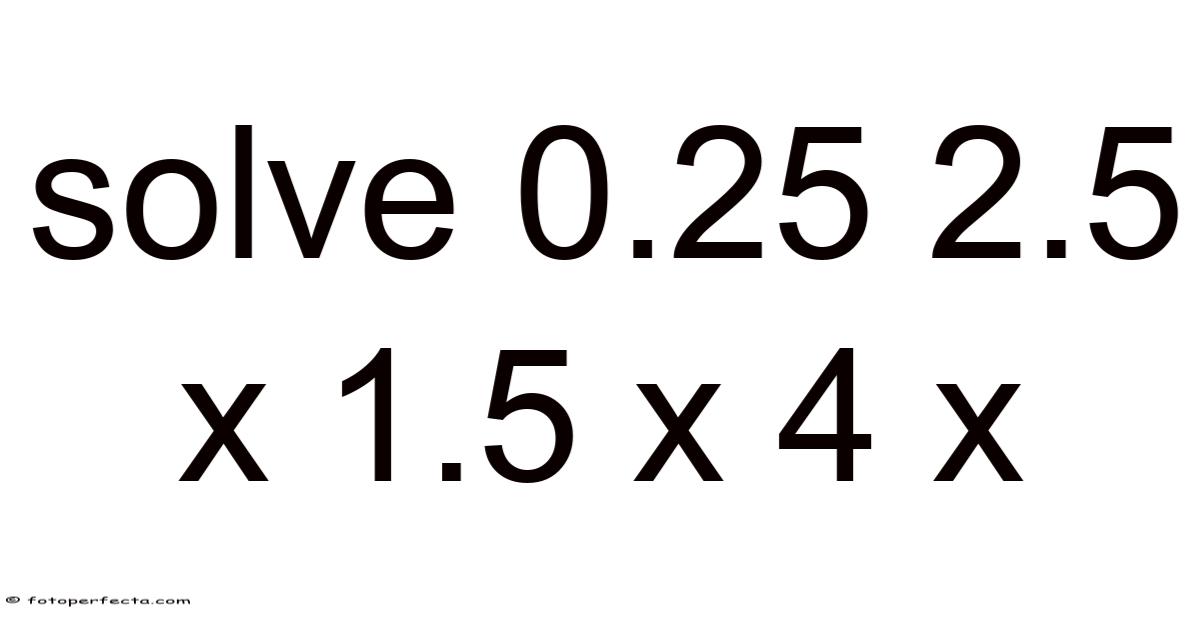
How to Solve 0.In practice, 25 × 2. 5 × 1.
Understanding how to multiply decimal numbers is a fundamental skill in mathematics, essential for both academic success and everyday problem-solving. On top of that, the expression 0. Think about it: 25 × 2. 5 × 1.5 × 4 may seem straightforward, but it requires careful attention to decimal placement and multiplication steps. This article will walk you through the process of solving this equation, explain the underlying principles, and provide tips to avoid common mistakes.
Introduction to Decimal Multiplication
Decimal multiplication involves multiplying numbers with decimal points, which can sometimes be tricky due to the need to correctly position the decimal in the final answer. Also, when faced with an expression like 0. 25 × 2.5 × 1.5 × 4, it’s helpful to break the problem into smaller parts and apply systematic steps. This ensures accuracy and builds confidence in handling similar calculations Worth knowing..
Step-by-Step Solution to 0.25 × 2.5 × 1.5 × 4
Method 1: Multiplying Decimals Directly
Let’s tackle the problem step by step, multiplying the numbers in sequence:
-
First Multiplication:
Multiply 0.25 and 2.5:- 0.25 × 2.5 = 0.625
- To calculate this, ignore the decimals initially: 25 × 25 = 625. Since there are four decimal places total (two in 0.25 and two in 2.5), place the decimal four places from the right: 0.625.
-
Second Multiplication:
Multiply the result (0.625) by 1.5:- 0.625 × 1.5 = 0.9375
- Again, ignore the decimals first: 625 × 15 = 9375. There are three decimal places (three in 0.625 and one in 1.5), so place the decimal accordingly: 0.9375.
-
Final Multiplication:
Multiply 0.9375 by 4:- 0.9375 × 4 = 3.75
- Here, 9375 × 4 = 37500. With three decimal places, the result becomes 3.75.
Method 2: Converting Decimals to Fractions
For a more precise approach, convert each decimal to a fraction:
- 0.25 = 1/4
- 2.5 = 5/2
- 1.5 = 3/2
- 4 = 4/1
Now multiply the fractions:
(1/4) × (5/2) × (3/2) × (4/1) = (1 × 5 × 3 × 4) / (4 × 2 × 2 × 1) = 60/16
Simplify the fraction by dividing numerator and denominator by 4:
60 ÷ 4 = 15; 16 ÷ 4 = 4 → 15/4
Convert 15/4 back to a decimal:
15 ÷ 4 = 3.75
Both methods yield the same result: 3.75.
Scientific Explanation: Why These Methods Work
Decimal multiplication relies on the commutative property of multiplication, which allows us to rearrange numbers without changing the product. Additionally, converting decimals to fractions leverages the fundamental theorem of arithmetic, ensuring that multiplication remains consistent regardless of representation. By simplifying fractions before converting back to decimals, we reduce the chance of computational errors.
Common Mistakes and Tips
When solving **0.25 × 2.5 × 1.
- Incorrect Decimal Placement: Forgetting to account for the total number of decimal places in the final answer. Always count the decimal places in each number before multiplying.
- Arithmetic Errors: Miscalculating when multiplying large numbers. Double-check intermediate steps to avoid compounding errors.
- Ignoring Simplification: Converting decimals to fractions can simplify complex multiplications, especially with repeating decimals.
Tips for Success:
- Use a calculator for verification, but understand the manual process.
- Practice with simpler decimals first, such as 0.1 × 0.2, before advancing to more complex expressions.
Conclusion
The multiplicationof 0.25 × 2.Which means 5 × 1. Because of that, whether approached through sequential decimal multiplication or fraction conversion, both methods validate the result of 3. So 5 × 4 exemplifies how mathematical principles can simplify seemingly complex calculations. Worth adding: 75, demonstrating the reliability of foundational math concepts. The commutative property ensures flexibility in rearranging terms, while fraction simplification reduces computational load, particularly when dealing with repeating or non-terminating decimals.
This problem also highlights the importance of attention to detail, such as correctly counting decimal places or reducing fractions to their simplest form. By practicing these techniques, learners not only master specific calculations but also develop a deeper understanding of numerical relationships. In real-world applications—from financial calculations to scientific measurements—such precision is indispensable.
You'll probably want to bookmark this section.
At the end of the day, the ability to switch between decimal and fractional representations empowers individuals to choose the most efficient method for any given scenario. As mathematics continues to underpin technological and analytical advancements, proficiency in these basic operations remains a cornerstone of problem-solving. Embracing both manual and digital tools, while avoiding common pitfalls, ensures accuracy and confidence in tackling a wide range of numerical challenges Took long enough..
Exploring the process further, the transformation from decimals to fractions not only reinforces arithmetic accuracy but also strengthens logical thinking. Each fraction we derive acts as a stepping stone, preparing us for more advanced algebraic manipulations. This approach underscores the interconnectedness of mathematical concepts, where understanding one idea naturally leads to clearer solutions in others Not complicated — just consistent..
On top of that, recognizing patterns in decimal repetitions or simplifying early can save significant time and reduce confusion. It’s essential to stay methodical, especially when tackling multi-step problems. By applying these strategies consistently, learners build a strong foundation that supports further exploration And it works..
Most guides skip this. Don't.
The short version: the journey through this calculation not only yields a precise answer but also emphasizes the value of precision, patience, and adaptability in mathematics. Embracing these principles equips us to handle a broader spectrum of challenges with confidence.
Concluding this exploration, it’s clear that mastering these methods enhances both comprehension and efficiency. The seamless transition between representation forms is a testament to the elegance of mathematics, reminding us of its power in everyday problem-solving.
