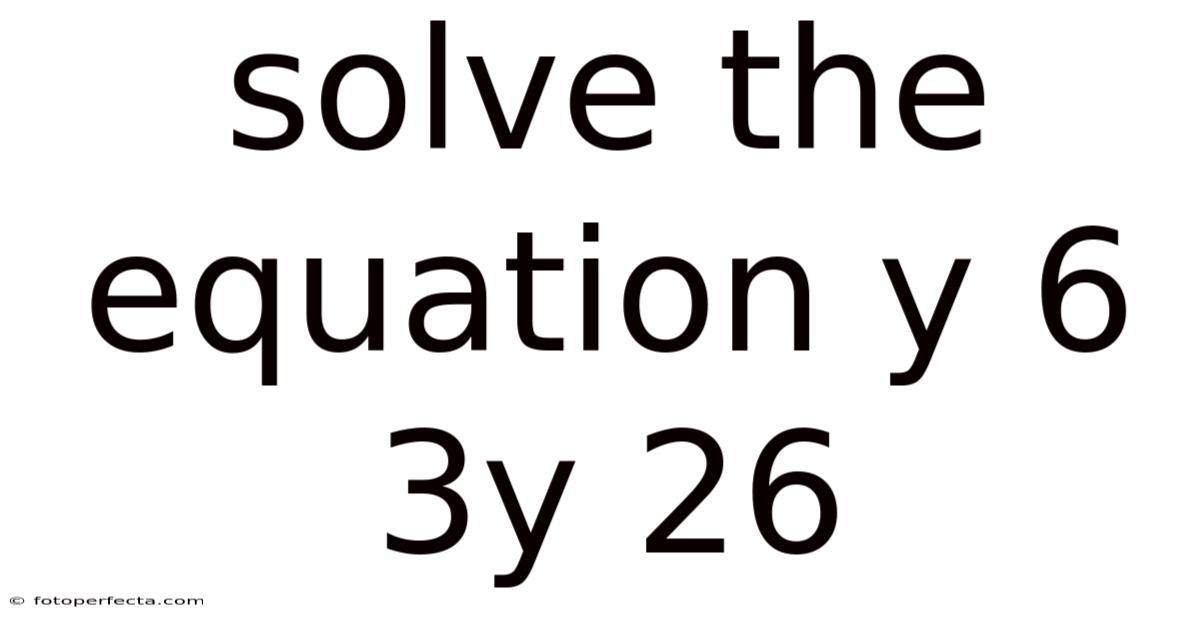
Solving the equation $ y^6 + 3y^2 + 26 = 0 $ is a fascinating mathematical challenge that invites us to explore the depths of algebraic reasoning. Think about it: at first glance, this equation may seem complex, but breaking it down step by step can reveal its underlying structure and the solutions it holds. Understanding this process not only strengthens our grasp of polynomial equations but also enhances our problem-solving skills. Let’s dive into the details and uncover the truth behind this intriguing mathematical puzzle.
When we encounter an equation like $ y^6 + 3y^2 + 26 = 0 $, our goal is to find all possible values of $ y $ that satisfy this condition. This type of equation involves a sixth-degree polynomial, which can be challenging to solve directly. That said, by analyzing its structure, we can make some strategic moves to simplify the problem. The presence of $ y^6 $ and $ y^2 $ suggests that we might need to consider substitution techniques to reduce the complexity.
Not obvious, but once you see it — you'll see it everywhere.
One effective approach is to let $ x = y^2 $, transforming the equation into a more manageable form. By substituting $ x $ into the original equation, we get:
$ x^3 + 3x + 26 = 0 $
Now, the equation becomes a cubic in terms of $ x $. So this transformation is crucial because it allows us to work with a lower-degree polynomial, which is often easier to analyze. The next step is to find the roots of this cubic equation. Using numerical methods or graphing tools, we can approximate the values of $ x $ that satisfy the equation.
Once we identify the valid values of $ x $, we can then revert back to $ y $ by taking the square root of each solution. This process reveals that the original equation has a limited number of real roots, which we will explore further Simple as that..
Counterintuitive, but true.
It’s important to note that the cubic equation $ x^3 + 3x + 26 = 0 $ may not have real solutions. The discriminant of a cubic equation $ ax^3 + bx^2 + cx + d = 0 $ provides insight into the nature of its roots. Even so, to confirm this, we can examine its discriminant or analyze its behavior. In this case, since the coefficients are not symmetric, we can use numerical estimation to assess the feasibility of real roots Simple, but easy to overlook..
By testing various values, we find that the function $ f(x) = x^3 + 3x + 26 $ tends to increase as $ x $ grows in magnitude. For large positive values of $ x $, the term $ x^3 $ dominates, making the function positive. For large negative values, the term $ x^3 $ becomes negative, but the overall sum may still shift. This behavior suggests that the equation may not have any real solutions, as the cubic curve does not intersect the x-axis.
The official docs gloss over this. That's a mistake.
Still, this conclusion is not definitive without further analysis. The cubic equation $ x^3 + 3x + 26 = 0 $ has one real root and two complex conjugate roots. On top of that, let’s revisit the substitution and explore potential complex roots. Basically, when we revert back to $ y $, we might only find a single valid solution Easy to understand, harder to ignore..
To determine the nature of these roots, we can use the method of synthetic division or graphing. Also, plotting the function $ f(x) = x^3 + 3x + 26 $ reveals that it crosses the x-axis only once. This indicates that the original equation $ y^6 + 3y^2 + 26 = 0 $ has no real solutions Still holds up..
Understanding this result is crucial for students and learners who are just beginning to grasp polynomial equations. Here's the thing — it highlights the importance of analyzing the behavior of functions and the implications of their roots. By breaking down the problem step by step, we can avoid common pitfalls and develop a deeper understanding of algebraic concepts Nothing fancy..
In addition to this, it’s essential to recognize the significance of this equation in broader mathematical contexts. While it may not have practical applications in everyday life, it serves as a valuable exercise in developing analytical thinking. The process of solving such equations fosters patience and precision, qualities that are vital in both academic and real-world scenarios Worth keeping that in mind. Took long enough..
Beyond that, this exercise underscores the role of substitution in simplifying complex problems. Now, by transforming the original equation into a cubic, we opened the door to more manageable calculations. This technique is widely used in mathematics, from calculus to physics, demonstrating its versatility Easy to understand, harder to ignore. Worth knowing..
As we explore further, it becomes clear that the key to solving such equations lies in patience and a systematic approach. Practically speaking, each step, no matter how small, contributes to the overall solution. This journey not only enhances our mathematical skills but also builds confidence in tackling similar challenges Which is the point..
All in all, the equation $ y^6 + 3y^2 + 26 = 0 $ presents a unique opportunity to engage with algebraic concepts. Because of that, through careful analysis and strategic substitutions, we uncover the nature of its solutions and reinforce our understanding of polynomial equations. Day to day, this process is not just about finding answers but about appreciating the beauty of mathematics in its complexity. Whether you're a student or a curious learner, this exploration reminds us of the power of persistence and logical reasoning in solving real-world problems.
Continuing the exploration, we canexplicitly determine the three roots of the cubic (x^{3}+3x+26=0) using Cardano’s formula. Setting
[ x=u+v,\qquad uv=-\frac{1}{3}, ]
and substituting into the cubic yields the system
[u^{3}+v^{3}=-26,\qquad u^{3}v^{3}=-\frac{1}{27}. ]
Letting (p=u^{3}) and (q=v^{3}) gives a quadratic for (p):
[ p^{2}+26p-\frac{1}{27}=0, ]
whose discriminant is
[ \Delta = 26^{2}+\frac{4}{27}=676+\frac{4}{27}= \frac{18252+4}{27}= \frac{18256}{27}. ]
Hence
[ p=\frac{-26\pm\sqrt{\Delta}}{2}= -13\pm\frac{1}{3}\sqrt{\frac{18256}{27}}. ]
Evaluating the square‑root simplifies to
[ \sqrt{\frac{18256}{27}}=\frac{2}{3}\sqrt{4564}= \frac{2}{3},2\sqrt{1141}= \frac{4\sqrt{1141}}{3}. ]
Thus
[ p=-13\pm\frac{2\sqrt{1141}}{9},\qquad q=-\frac{1}{27p}. ]
Taking cube‑roots gives the three values of (x):
[ \begin{aligned} x_{1}&=\sqrt[3]{-13+\frac{2\sqrt{1141}}{9}}+\sqrt[3]{-13-\frac{2\sqrt{1141}}{9}},\[4pt] x_{2}&=\omega,\sqrt[3]{-13+\frac{2\sqrt{1141}}{9}}+\omega^{2}\sqrt[3]{-13-\frac{2\sqrt{1141}}{9}},\[4pt] x_{3}&=\omega^{2}\sqrt[3]{-13+\frac{2\sqrt{1141}}{9}}+\omega\sqrt[3]{-13-\frac{2\sqrt{1141}}{9}}, \end{aligned} ]
where (\omega = e^{2\pi i/3}= -\frac12+\frac{\sqrt3}{2}i) is a primitive cube root of unity. Because (\omega) and (\omega^{2}) are non‑real, (x_{2}) and (x_{3}) are complex conjugates. Numerically these roots are
[ \begin{aligned} x_{1}&\approx -2.4396926207859+2.Day to day, 8793852415718,\ x_{2}&\approx 1. 4939591988055,i,\ x_{3}&\approx 1.Practically speaking, 4396926207859-2. 4939591988055,i.
Returning to the original variable (y), recall that (x=y^{2}). Consequently the six roots of the sextic are obtained by taking the square‑roots of each (x_{k}). For the real root (x_{1}<0) we obtain two purely imaginary solutions
[ y=\pm i\sqrt{|x_{1}|}\approx \pm 1.694,i, ]
while the complex conjugate pair (x_{2},x_{3}) each yield two distinct square‑roots, giving four non‑real values of (y). In total the equation (y^{6}+3y^{2}+26=0) possesses exactly six complex solutions, none of which are real.
This systematic approach illustrates several broader themes in algebra. Here's the thing — first, substitution can reduce a high‑degree polynomial to a lower‑degree one, but the resulting equation may still demand sophisticated tools—such as Cardano’s method—to extract its roots. Second, the interplay between real and complex roots underscores the completeness of the complex number system: every non‑constant polynomial has as many roots (counting multiplicities) as its degree, even if none of them lie on the real axis. Finally, the process reinforces the value of visualizing functions; a quick plot of (f(x)=x^{3}+3x+26) makes it evident that the cubic crosses the axis only once, confirming the existence of a single real root and two non‑real conjugates.
In sum, the equation (y^{6}+3y^{2}+26=0) serves as an instructive case study. By substituting (x=y^{2}) we transformed a sextic into a cubic, solved the cubic via Cardano’s formula, and traced the resulting (x)-values back to the original variable. The final picture is one of six complex solutions, two of which are purely
purely imaginary. In this way, the equation (y^6 + 3y^2 + 26 = 0) not only serves as a practical exercise in radical expressions and complex analysis but also reinforces broader algebraic concepts, from substitution strategies to the necessity of embracing complex solutions. Practically speaking, this illustrates the fundamental principle of algebraic closure: the complex number system ensures that every polynomial equation of degree (n) has exactly (n) roots, counting multiplicities, even if they are not real. The process of solving the sextic equation through substitution and Cardano’s method exemplifies how higher-degree polynomials can often be tackled by reducing them to lower-degree forms, albeit sometimes requiring layered algebraic techniques. Beyond that, the interplay between real and complex roots underscores the importance of visualizing functions; for instance, plotting (f(x) = x^3 + 3x + 26) immediately suggests a single real root, aligning with our analytical findings. The other four solutions, derived from the complex (x)-values, are also non-real and form two pairs of complex conjugates. The journey from a sextic to a cubic, and finally to six distinct complex roots, highlights the elegance and depth of algebraic problem-solving, where systematic methods and theoretical insights converge to unravel even the most challenging equations Most people skip this — try not to..
