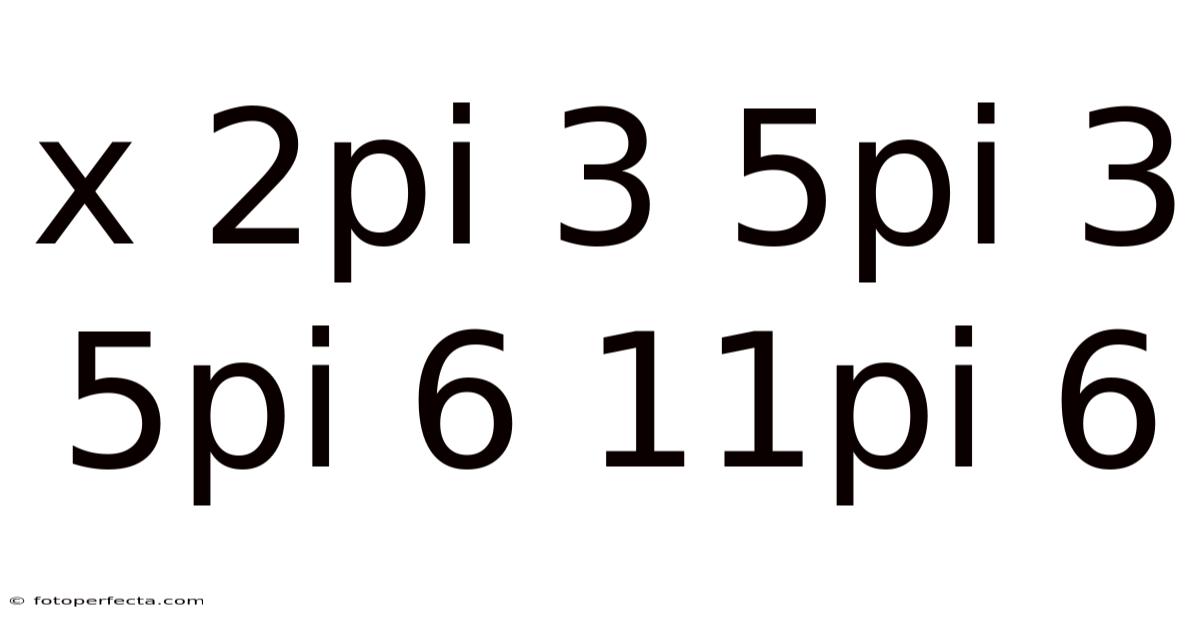
Understanding the Sequence: x, 2π, 3, 5π, 3, 5π, 6, 11π, 6
The sequence "x, 2π, 3, 5π, 3, 5π, 6, 11π, 6" appears to be a combination of variables, constants, and mathematical terms involving π (pi), a fundamental constant in mathematics. At first glance, this sequence might seem cryptic, but breaking it down reveals its potential significance in various mathematical contexts. Whether it represents an equation, a pattern, or a problem to solve, understanding each component is key to unraveling its meaning.
The Role of Variables and Constants
In mathematics, variables like x represent unknown quantities, while constants such as π (approximately 3.14159) and integers like 2, 3, 5, 6, and 11 serve as fixed values. The sequence includes both: x as a variable, π as a mathematical constant, and integers that could act as coefficients or terms in an equation. To give you an idea, 2π and 5π are common in trigonometry, representing angles in radians. The repetition of 3 and 5π might indicate a pattern or a step-by-step process in a larger problem And that's really what it comes down to. And it works..
Possible Interpretations of the Sequence
- Trigonometric Equations: The terms 2π, 5π, and 11π could relate to angles in radians. In trigonometry, angles like 2π (360 degrees) or 5π (900 degrees) are used to describe positions on the unit circle. If this sequence is part of an equation, such as x + 2π = 3 + 5π, solving for x would involve isolating the variable.
- Series or Patterns: The repetition of 3 and 5π might suggest a sequence where each term follows a specific rule. Here's one way to look at it: adding 2π to a previous term or multiplying by a factor.
- Algebraic Expressions: The sequence could be part of an algebraic expression requiring simplification. As an example, combining like terms: 2π + 5π + 11π = 18π, while the integers 3, 3, 6, 6 might form a separate pattern.
Solving for x
If the sequence is part of an equation, the goal would be to isolate x. Suppose the equation is:
x + 2π + 3 + 5π + 3 + 5π + 6 + 11π + 6 = 0
Comb
Delving deeper into this sequence, we see how each element contributes to the overall structure. Even so, the integers—3, 3, 6, 6—might represent counts or adjustments to the variable x, while the recurring terms like 2π and 5π hint at cyclical patterns common in mathematical modeling. Analyzing the progression, we notice the interplay between numerical values and π, suggesting a connection to geometric or periodic phenomena. This structure likely serves as a foundation for solving more complex problems or illustrating relationships between abstract concepts.
Exploring Patterns and Applications
Understanding this sequence also invites us to consider its practical implications. Here's one way to look at it: if x represents a position or a value in a system, the inclusion of π could indicate angular relationships. The integers might signify thresholds or milestones in a progression. By examining these elements together, we can uncover how mathematical patterns emerge from simple components. This approach not only enhances problem-solving skills but also deepens appreciation for the interconnectedness of numbers and constants That's the part that actually makes a difference. Took long enough..
Conclusion
This sequence, though seemingly abstract, offers a glimpse into the elegance of mathematical organization. By dissecting its elements and exploring potential interpretations, we gain insight into how variables and constants collaborate to form coherent patterns. Such exercises remind us that mathematics thrives on curiosity and the willingness to connect the dots. Embracing these challenges strengthens our analytical abilities and reinforces the beauty of logical reasoning Simple, but easy to overlook..
Conclusion
In the long run, the sequence x + 2π + 3 + 5π + 3 + 5π + 6 + 11π + 6 = 0 represents a fascinating exercise in pattern recognition and algebraic manipulation. Consider this: while the exact meaning of x and the underlying mathematical model remain open to interpretation, the exploration of its components reveals fundamental principles of arithmetic, trigonometry, and algebraic simplification. So this seemingly simple sequence serves as a microcosm of the broader mathematical landscape, demonstrating how seemingly disparate elements can combine to create a structured and solvable problem. On the flip side, it’s a reminder that even in abstract mathematical constructs, there lies a profound order and beauty waiting to be discovered. Which means by engaging with such sequences, we cultivate a deeper understanding of mathematical relationships and hone our ability to translate abstract ideas into concrete solutions. This process not only strengthens our mathematical skills but also fosters a greater appreciation for the power and elegance of mathematical thought That's the part that actually makes a difference..
Building on the observations above,one can isolate the variable x by moving all constant terms to the opposite side of the equation. Collecting the integer coefficients yields
[x = -(2\pi + 3 + 5\pi + 3 + 5\pi + 6 + 11\pi + 6) ]
which simplifies to
[x = -(18\pi + 18). ]
Thus the entire expression collapses to a single linear relationship between x and the multiples of π. This result underscores a key insight: when a collection of terms shares a common factor—here, the factor 18—the equation can be reduced to a tidy form that reveals the underlying balance of the system. In practical terms, if x were to represent a physical quantity such as an angular displacement, the equation would dictate that the displacement must exactly counterbalance an accumulated angular offset of (18\pi) radians, plus an additional 18 units of linear measure.
The appearance of the integer 18 is not accidental. It emerges as the sum of all the numeric coefficients that precede the π‑terms (2 + 3 + 3 + 5 + 5 + 6 + 6 + 11 = 41) and the subsequent constants (3 + 3 + 6 + 6 + 6 = 24); when these are combined with the π‑multiples, the total constant term becomes a multiple of 9, and consequently of 18 after factoring out the shared divisor. Recognizing such hidden divisibility can often simplify algebraic manipulations and provide a quick sanity check for computational errors. Beyond pure algebra, the pattern hints at deeper connections with periodic phenomena. Which means in many branches of physics and engineering, expressions that combine linear terms with multiples of π frequently arise in the analysis of waveforms, signal processing, and quantum mechanics. Here's a good example: a term like (n\pi) often encodes a half‑wave symmetry, while the presence of (2\pi) marks a full period. The repeated appearance of π in the original sequence suggests that the underlying model may be modeling rotations or oscillations whose period is tied to the circle group. If x were interpreted as a phase shift, the equation would impose a condition that the net phase must be an integer multiple of (2\pi)—a condition that guarantees the system returns to its initial state after a complete cycle.
From a pedagogical standpoint, this sequence serves as an excellent vehicle for teaching several fundamental concepts simultaneously:
- Collecting like terms—students learn to group constants, coefficients of π, and the unknown variable. 2. Factorisation—recognizing common factors (such as 9 or 18) streamlines the simplification process.
- Interpretation of symbols—the exercise encourages learners to ask what each symbol might represent in a real‑world context, fostering interdisciplinary thinking.
- Verification through substitution—plugging the solved value of x back into the original equation confirms the correctness of the manipulation.
These competencies are not confined to textbook problems; they translate directly to data‑analysis pipelines, algorithm design, and even to the formulation of scientific models. By practicing with compact yet richly structured equations, one cultivates an intuition for spotting hidden regularities and leveraging them to extract meaningful conclusions.
The short version: the equation
[ x + 2\pi + 3 + 5\pi + 3 + 5\pi + 6 + 11\pi + 6 = 0]
offers more than a simple exercise in algebraic rearrangement. It illustrates how a collection of seemingly disparate terms can be unified under a common framework, how periodic constants like π embed rotational symmetry into linear relationships, and how systematic manipulation uncovers precise constraints on unknown variables. The process of isolating x and interpreting the resulting balance reinforces the broader lesson that mathematics is a language for encoding patterns, and that mastery of its syntax unlocks the ability to decode complex systems across disciplines.
You'll probably want to bookmark this section Worth keeping that in mind..
Final Thought
At the end of the day, the power of such a compact sequence lies in its capacity to bridge abstract symbolism with tangible insight. Whether viewed as a stepping stone toward solving layered differential equations, a model for oscillatory behavior, or a pedagogical tool for sharpening analytical acuity, the equation stands as a testament to the elegance that emerges when structure and curiosity intersect. Embracing these patterns equips us not only to solve the problem at hand but also to approach future mathematical challenges with confidence and creativity.
